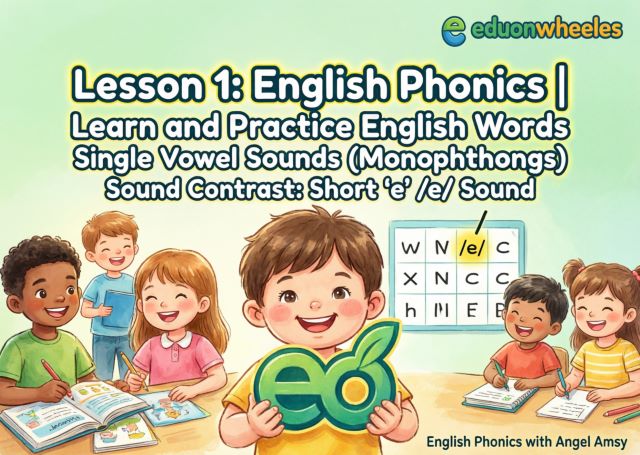
Lesson 1.3: Short ‘e’: /e/: Single Vowel Sounds (Monophthongs) | English Phonics – Learn and Practice English Words Simplified Videos: 1 and 2
Mastering the Short ‘e’ /e/ Sound: A Comprehensive Guide to English Monophthongs and Spelling Patterns
Introduction
In the journey toward English fluency, pronunciation is often the barrier that separates intermediate learners from advanced speakers. At Eduonwheels, we believe that clarity begins with the fundamentals. Welcome to Lesson 1 of our Simplified English Series, where we dissect the Short ‘e’ /e/ sound. This monophthong is ubiquitous in the English language, yet its varied spelling patterns can confuse even seasoned students. Whether you are targeting a neutral International English accent, refining your British Received Pronunciation (RP), or adapting to American English standards, mastering the /e/ sound is non-negotiable for clear communication.
Master listening, speaking, reading, and writing with Eduonwheels’ English Phonics program for beginners. Images: 2
Short ‘a’: /æ/ vs Long ‘a’: /a:/ – Single Vowel Sounds | English Phonics
The Importance of Monophthongs in Global Communication
Monophthongs are pure vowel sounds where the tongue remains in a single position during pronunciation. Unlike diphthongs, which glide from one sound to another, the /e/ sound is crisp and short. For students preparing for high-stakes exams such as the WAEC and JAMB in Nigeria, or IELTS and TOEFL globally, precise vowel production significantly impacts listening and speaking scores. Mispronouncing /e/ as /ɪ/ (as in sit) or /æ/ (as in cat) can lead to misunderstandings in professional settings.
Deconstructing the /e/ Sound: Spelling Patterns Explained
The challenge with the /e/ sound lies not in its production, but in its orthography. English is not a phonetic language; one sound can be represented by multiple letter combinations. Eduonwheels simplifies these patterns into digestible categories.
1. The Standard ‘e’ Pattern The most common representation is the single letter ‘e’. Examples include men, pen, bell, test, end, chest, dress, echo, edge, and egg. These are foundational words for CEFR Level A1 learners. Practice saying these words with a relaxed jaw and a slightly raised tongue tip.
2. The ‘ea’ Digraph Often associated with the long /i:/ sound (as in tea), the ‘ea’ combination frequently produces the short /e/ sound. Key examples include death, head, read (past tense), lead (metal), dead, bread, health, wealth, instead, and breath. Recognizing this pattern is crucial for reading comprehension and accurate pronunciation.
3. The ‘a’ Anomaly Certain words use the letter ‘a’ to produce the /e/ sound. This is an irregularity that must be memorized. The primary examples are many, any, ate, and says. Note that “ate” is pronounced /et/ in American English, aligning with the /e/ sound, though British English may vary.
4. The ‘ai’ and ‘ei’ Exceptions While ‘ai’ usually makes the /e/ sound (as in rain), exceptions like said and again use the short /e/. Similarly, ‘ei’ typically makes the /i:/ sound (as in receive), but words like heifer, leisure, and Leicester defy this rule.
5. Rare Patterns: ‘ie’, ‘eo’, and ‘u’ English loves its outliers. The word friend uses ‘ie’ to make /e/. The ‘eo’ digraph appears in leopard, Leonard, jeopardy, and Geoffrey. Perhaps the most surprising is the letter ‘u’ in the word bury, which is pronounced exactly like berry.
Educational Benefit for Global Learners
For learners in Brazil, Vietnam, Indonesia, Japan, and South Korea, vowel length and quality are distinct phonemic features. By isolating the /e/ sound, Eduonwheels helps learners avoid common interlanguage errors. Our simplified method ensures that you do not just memorize words, but understand the underlying phonetic logic.
Conclusion
Mastering the Short ‘e’ /e/ sound is a cornerstone of English phonics. By recognizing these diverse spelling patterns, you enhance both your reading accuracy and speaking confidence. Join Eduonwheels as we continue to simplify English learning for the world.
References
1. British Council. (2023). English Pronunciation: Vowel Sounds. British Council Learning Resources.
2. Hancock, M. (2017). English pronunciation in use: Elementary (2nd ed.). Cambridge University Press.
3.
Eduonwheels. (2026). Lesson 1: English Phonics – Short ‘e’ /e/ Sound [Video]. Eduonwheels Global English Platform.Lesson 1.3: Short ‘e’: /e/: Single Vowel Sounds (Monophthongs) | English Phonics – Learn and Practice English Words Simplified Videos: 1 and 2
Lesson 1.3: Short ‘e’: /e/: Single Vowel Sounds (Monophthongs) | English Phonics – Learn and Practice English Words Simplified Videos: 1 and 2



0 Comments