How to Draw and Color (Colour) a Dog in 5 Simple Ways: Learn and Practice (Practise) Animals Drawing and Coloring – Dog
How to Draw and Color (Colour) a Dog in 5 Simple Ways: Learn and Practice (Practise) Animals Drawing and Coloring – Dog
| Easy Step-by-step Pencil Sketch Art Drawing Ideas and Coloring (Colouring) and Arts and Crafts Do It Yourself (DIY) Projects for Kids, Beginners and Learners – Cartoons, Animes, Animations of Natural and Man-made Objects
| Eduonwheels’ Simplified Arts and Craft Online Video Tutorials]
How to Draw and Color (Colour) a Dog in 5 Simple Ways: A Step-by-Step Guide for Kids and Beginners
Introduction
Dogs are often called “man’s best friend,” and for good reason! They are loyal, playful, and full of personality. For children and beginners, capturing that personality on paper can be a delightful challenge. At Eduonwheels, we believe that art should be accessible, fun, and educational for everyone. That is why we have created this comprehensive guide on how to draw and color (colour) a dog in 5 simple ways.
Whether you are a parent looking for a quiet afternoon activity, a teacher planning an art lesson, or a young artist eager to learn, this tutorial is designed just for you. By using simple shapes, numbers, and letters, we transform complex anatomy into easy-to-follow steps. Join us as we explore five unique methods to sketch your very own canine companion!
Topic Overview
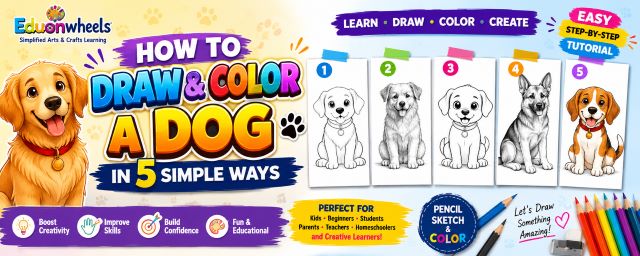
This video lesson, titled “How to Draw and Color (Colour) a Dog in 5 Simple Ways,” breaks down the art of sketching into manageable chunks. Instead of worrying about perfect proportions immediately, learners use familiar characters from the alphabet and number line—like the number ‘2’, the number ‘6’, the letter ‘K’, and the circle ‘0’—as the building blocks for their drawings. This approach not only simplifies the process but also reinforces literacy and numeracy skills in a creative context.
Why This Project is Important
Drawing is more than just a hobby; it is a fundamental developmental tool. Learning and practicing (practising) animal drawing, specifically dogs, helps children:
- Develop Fine Motor Skills: Holding a pencil and controlling lines strengthens hand muscles.
- Enhance Hand-Eye Coordination: Translating what they see in their mind onto paper requires precise coordination.
- Boost Confidence: Completing a drawing gives a sense of achievement.
- Foster Creativity: Once the basic structure is down, the coloring (colouring) phase allows for endless imagination.
Materials Required
To get started with these easy step-by-step drawing ideas, you will need:
- Paper: Standard white drawing paper or a sketchbook.
- Pencil: An HB or No. 2 pencil is perfect for sketching guidelines.
- Eraser: For correcting mistakes and cleaning up guidelines.
- Coloring (Colouring) Tools: Crayons, colored pencils, markers, or watercolors.
- Sharpener: To keep your pencil point fine for details.
Step-by-Step Instructions: 5 Ways to Draw a Dog
Method 1: The “Two 6s” Technique
This method is excellent for drawing a cute, front-facing puppy face.
- Draw the Ears/Head: Start by drawing the number ‘6’. Next to it, draw a mirrored ‘6’ (which looks like a backwards ‘6’). These two shapes form the floppy ears and the sides of the head.
- Connect the Top: Draw a curved line connecting the tops of the two ‘6s’ to complete the head shape.
- Add Facial Features: Inside the head, draw two oval eyes with pupils. Add a small nose and a smiling mouth below.
- Body and Legs: Draw a rounded body underneath the head. Add two front legs and a collar with stripes.
- Tail: Finish with a curved tail on the side.
Method 2: The “Two 2s” Technique
This method creates a side-profile dog, looking very much like a Dachshund or a playful pup.
- The First ‘2’: Draw a large number ‘2’. The top curve becomes the head and neck, and the diagonal line becomes the chest and front leg.
- The Second ‘2’: Draw another ‘2’ to the right, but slightly lower. The top curve forms the back and tail, while the bottom line forms the hind leg.
- Connect the Body: Draw a long line connecting the neck area to the back to form the torso.
- Details: Add an eye, a floppy ear, and paws. Connect the legs with a belly line.
Method 3: The “Six 0s” (Circles) Technique
This is a fun, geometric way to draw a dog lying down.
- The Base: Draw a row of circles (0s). In the video, these form the paws and the lower body structure.
- The Head: Draw a larger oval or circle above the central paws for the head.
- Connecting Lines: Connect these circles with smooth lines to form the body, ears, and snout.
- Features: Add eyes, a nose, and a tongue hanging out.
- Tail: Add a curved tail at the back.
Method 4: The “Letter K” Technique
Using the alphabet is a fantastic way to integrate literacy into art.
- Draw a ‘K’: Write a capital letter ‘K’. The vertical line is the front leg, and the angled lines are the chest and belly.
- Head: Draw a curved shape at the top of the vertical line for the head and snout.
- Back and Tail: Extend a line from the top of the ‘K’ backwards to create the back, curving up for the tail.
- Hind Leg: Draw the back leg extending from the bottom of the ‘K’ structure.
- Finish: Add an ear, eye, and a collar/bow.
Method 5: The “Four 2s” Technique
This variation uses multiple ‘2’s to create a standing dog.
- Legs: Draw four ‘2’s. Two will serve as the front legs, and two as the back legs (or parts of the body structure).
- Body Connection: Connect the tops of these ‘2’s with a long horizontal line for the back.
- Head: Add a head shape at the front.
- Details: Fill in the ears, eyes, and tail to complete the look.
Coloring (Colouring) Techniques
Once your sketch is complete, it’s time to bring it to life!
- Realistic Colors: Use browns, blacks, whites, and tans to mimic real dog breeds like Golden Retrievers or Dalmatians.
- Creative Colors: Encourage children to use purple, blue, or red to make a fantasy dog.
- Shading: Teach beginners to press harder on the pencil or marker in shadowed areas (like under the belly or behind the ears) to create depth.
Common Mistakes and How to Avoid Them
- Pressing Too Hard: Beginners often press hard with their pencils, making erasing difficult. Tip: Use light strokes for the initial sketch.
- Skipping Guidelines: Jumping straight to the final line can lead to crooked drawings. Tip: Always draw the shapes (6s, 2s, Ks) lightly first.
- Rushing: Art takes time. Tip: Take a breath between steps.
Beginner Tips for Success
- Practice (Practise) Shapes: Before drawing the dog, practice drawing the numbers and letters on a separate piece of paper.
- Use References: Look at pictures of real dogs to see how their ears and tails look.
- Have Fun: There is no “wrong” way to draw a dog in art class!
Creative Variations
- Add a Background: Draw a doghouse, a bone, or a park.
- Accessories: Give your dog a hat, a bow tie, or a leash.
- Action: Try drawing the dog running or sleeping.
Educational Benefits and Skills Developed
This lesson aligns with early childhood development goals.
- Shape Recognition: Identifying how circles and lines form complex objects.
- Literacy and Numeracy: Reinforcing the shapes of ‘K’, ‘2’, ‘6’, and ‘0’.
- Concentration and Patience: Following a multi-step process requires focus.
- Independent Creation: Empowering kids to create something from scratch.
Frequently Asked Questions (FAQs)
Q: What if I don’t have colored pencils? A: You can use crayons, markers, or even watercolors. Black and white sketches are also beautiful!
Q: Which method is the easiest for a 4-year-old? A: Method 1 (The Two 6s) and Method 3 (The Six 0s) are usually the most intuitive for preschoolers because they rely on simple, repetitive shapes.
Q: Can adults use these tutorials? A: Absolutely! These simplified methods are great for warm-up sketches or for adults teaching children.
Conclusion
Drawing a dog doesn’t have to be complicated. By breaking it down into 5 simple ways using numbers and letters, Eduonwheels makes art accessible and enjoyable for learners of all ages. We hope you enjoyed learning and practicing (practising) animal drawing with us. Remember, every great artist started with a single line. Keep sketching, keep coloring (colouring), and keep creating!
Call-to-Action
Did you enjoy this tutorial? Rate us: Excellent, Very good, Good, Fair, or Poor in the comments below! Don’t forget to subscribe to Eduonwheels for more simplified arts and crafts online lessons. Share your dog drawings with us on social media!
Engagement Features
Discussion Questions:
- For Kids: Which number or letter was the most fun to turn into a dog?
- For Parents: How did your child react to using numbers for drawing? Did it help them remember the shapes better?
- For Teachers: How can you integrate this drawing lesson into a math or language arts class?
Homeschool Activity Suggestion: Create a “Dog Alphabet” book. Use the ‘K’ method for ‘K is for K9’ or the ‘2’ method for ‘2 Dogs’.
Creative Challenge: Try to draw your own pet (or a dream pet) using only circles and squares. How does it look?
Related Project Ideas:
- How to Draw a Cat using the letter ‘M’.
- How to Draw a Bird using the number ‘3’.
- DIY Dog Collar Craft using paper strips.
Accessibility & Media Descriptions
Featured Image Title: Easy Step-by-Step Dog Drawing Tutorial for Kids Image Alt Text: A collage of five simple pencil sketches of dogs, demonstrating different methods using numbers and letters like 6, 2, 0, and K. Caption: Learn to draw a dog in 5 simple ways with Eduonwheels. Description: An educational graphic showing five variations of dog sketches, ranging from a front-facing puppy made of ‘6’s to a side-profile dog made of ‘2’s, designed for beginner artists. Social Sharing Text: 🐶 Want to draw a cute dog? Learn 5 easy ways to sketch a puppy using numbers and letters! Perfect for kids and beginners. #Eduonwheels #ArtForKids Open Graph Description: Discover how to draw and color a dog in 5 simple ways. Easy, step-by-step art lessons for children and beginners using shapes, numbers, and letters. Pinterest Description: Easy Dog Drawing Tutorial! Learn 5 simple ways to draw a dog using numbers (2, 6, 0) and letters (K). Perfect art lesson for preschoolers and kids.
References
National Art Education Association. (2023). Why art education? https://www.arteducators.org/advocacy/why-art-education
The Kennedy Center. (n.d.). ArtsEdge: Drawing basics. https://artsedge.kennedy-center.org
Eduonwheels. (2026). How to draw and color (colour) a dog in 5 simple ways [Video]. YouTube.
Hashtags: #HowToDrawADog #ArtForKids #Eduonwheels #DrawingTutorial #EasyDrawing #KidsArt #StepByStepDrawing #ColoringPages #ArtEducation #DIYArt #LearnToDraw #DogDrawing #CreativeKids #HomeschoolArt #DrawingIdeas



0 Comments