Numeration: Comparing Whole Numbers – Easy Steps and Trick, Worked Examples, Test Questions And Answers
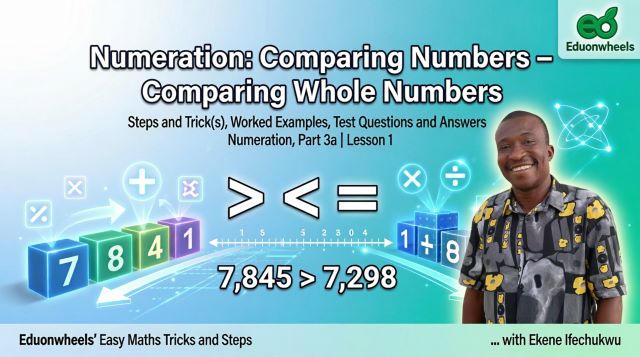
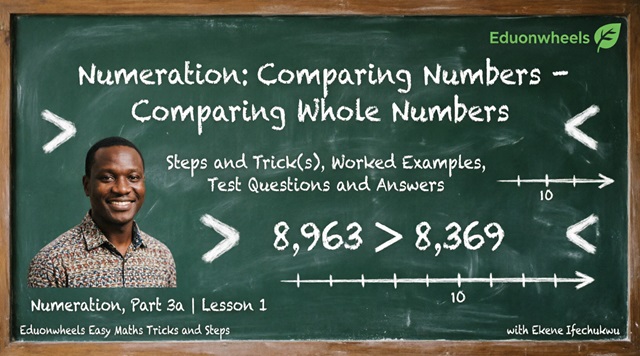
Lesson 1: Numeration, Part 3a: Comparing Number: Comparing Whole Numbers – Steps and Trick(s), Worked Examples, Test Questions and Answers
Unlock the secrets of Numeration with Eduonwheels. Learn the step-by-step trick to compare whole numbers instantly. Perfect for SATs, GCSEs, JAMB, and WASSCE preparation. Simplified Mathematics for global success.
Mastering Numeration: The Ultimate Guide to Comparing Whole Numbers for Global Exams (SATs, GCSEs, JAMB, WASSCE)
Welcome to the Eduonwheels Global Mathematics Hub, where we transform complex numerical concepts into “Simplified Mathematics” for students worldwide. In this comprehensive lesson, we dive deep into Lesson 1: Numeration, Part 3a, focusing specifically on the critical skill of Comparing Whole Numbers. Whether you are a student in the United States preparing for the SATs, a learner in the United Kingdom tackling GCSEs, or a candidate in Nigeria and West Africa gearing up for JAMB, WASSCE, or NECO, mastering the art of comparing numbers is foundational to your mathematical success.
The Challenge of Magnitude One of the most common stumbling blocks in early numeracy is determining the magnitude of large numbers. Students often struggle when faced with a mix of numbers having different digit lengths or when numbers share similar leading digits. This video addresses these challenges head-on with a structured, logical approach. We begin by establishing the fundamental rule: The number with more digits is always the bigger number. This simple heuristic is the first line of defense in comparison. For example, a 5-digit number like 47,156 will always be larger than a 4-digit number like 3,005, regardless of the specific digits used.
The “Elimination Trick”: A Game-Changer for Critical Thinking Moving beyond simple digit counting, this lesson introduces a powerful algorithmic trick for comparing numbers that have the same number of digits. This is where true critical thinking comes into play. The method involves writing the numbers line by line and “eliminating” equal digits starting from the left (the highest place value) and moving rightwards.
- Step 1: Align the numbers vertically.
- Step 2: Cross out identical digits in the same column.
- Step 3: The first column where the digits differ determines the winner. The number with the larger digit in that specific column is the larger number.
This technique is not just a shortcut; it is a visual representation of place value theory, reinforcing the concept that the position of a digit dictates its value. This is essential for students aiming for top marks in the IMO (International Mathematics Olympiad) or the AIME (American Invitational Mathematics Examination).
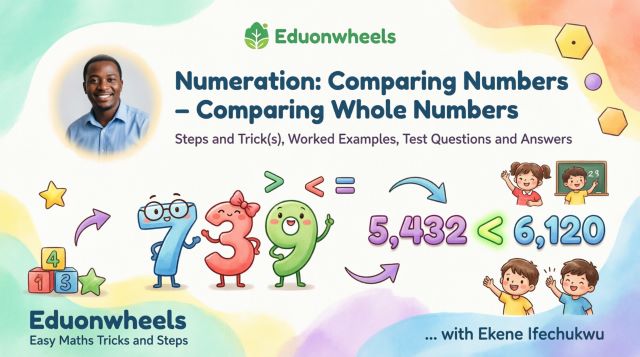
Math is fun! Join Ekene Ifechukwu to learn the secrets of comparing whole numbers with colorful characters and easy-to-follow examples.Images: 2
Worked Examples and Global Application We walk through rigorous worked examples, such as arranging the set {9635, 9653, 9658, 9640} in ascending and descending order. By applying the elimination trick, we visually demonstrate how 9658 emerges as the largest and 9635 as the smallest. This visual pedagogy is designed to cater to visual learners across diverse educational systems, from the CBSE/ICSE boards in India to the Cambridge A-Levels curriculum.
Test Yourself: Active Recall for Retention Education is not a spectator sport. To ensure mastery, we conclude with a “Test Yourself” section featuring challenging sets of numbers. We encourage students to pause the video, apply the steps, and verify their answers. This active recall method is proven to enhance long-term retention, a key strategy for success in high-stakes exams like the Putnam Competition or university entrance exams globally.
How do you currently teach place value to your students or children? Do you use visual aids like the “elimination trick” shown in this video, or do you rely on rote memorization? We invite you to share your teaching strategies or learning challenges in the comments below. Let’s build a global community of mathematical excellence!
Strategic Hashtags: #MathematicsEducation, #Numeration, #ComparingNumbers, #SATsPrep, #GCSEMaths, #JAMBMathematics, #WASSCE, #NECO, #CBSEMaths, #ICSE, #CambridgeALevels, #IBMath, #MathTricks, #PlaceValue, #Eduonwheels, #GlobalEducation, #STEMlearning, #MathOlympiad, #AIME, #PutnamExam, #SimplifiedMathematics, #BritishRP, #MathTutor, #OnlineLearning, #CriticalThinking
Academic Authority Citations:
1. Khan Academy. (n.d.). Comparing multi-digit numbers. https://www.khanacademy.org/math/arithmetic/arith-review-negative-numbers/arith-review-comparing-whole-numbers/v/comparing-whole-numbers 2. Eduonwheels. (2026). Lesson 1. Numeration, Part 3a: Comparing Whole Numbers – Steps and Trick(s) [https://youtu.be/UK2m_ptYa5g]. YouTube. https://www.eduonwheels.com Master the art of comparing large whole numbers with easy steps and tricks from Lesson 1 of our Numeration series. Images: 3
”Numeration: Comparing Whole Numbers – Steps and Trick, Worked Examples, Test Questions And Answers”



0 Comments