Numeration: How to Do Expansion of Whole and Decimal Numbers – Easy Steps & Tricks, Worked Examples, Test Questions and Answers
Lesson 1: Numeration, Part 4
4. Expansion of Numbers Expansion of Whole and Decimal Numbers
Steps and Tricks, Worked Examples, Test Questions and Answers
| Easy Maths Tricks and Steps | Eduonwheels’ Simplified Mathematics Online Lesson Videos for Critical Thinking, Decision-making and Problem-solving
Mastering Numeration: The Ultimate Guide to Expansion of Whole and Decimal Numbers for Global Exams
Introduction:
Mathematics is often called the universal language, but for many students, the dialect of “Numeration” can feel like a foreign tongue. One of the most foundational yet frequently misunderstood concepts is the Expansion of Numbers. Whether you are a student in Lagos preparing for JAMB, a learner in London tackling GCSEs, or a scholar in New York studying for the SATs, understanding how to break a number down into its constituent parts is crucial for developing critical thinking and problem-solving skills.
At Eduonwheels, our “Simplified Mathematics” approach aims to demystify these concepts. In this comprehensive guide, we will explore the easy steps and tricks to master the expansion of both whole and decimal numbers, ensuring you are ready for any standardized test, from the IMO to the WASSCE.
Why is Number Expansion Important?
Expansion is not just a rote exercise; it is the bedrock of place value understanding.
- Foundation for Algebra: Understanding that 43764376 is actually (4×1000)+(3×100)+(7×10)+(6×1)(4×1000)+(3×100)+(7×10)+(6×1) prepares the mind for polynomial expansion later in high school.
- Decimal Precision: In science and finance, understanding that 0.65390.6539 is composed of distinct values (0.6+0.05+0.003+0.00090.6+0.05+0.003+0.0009) is vital for accuracy.
- Global Standard: From the British National Curriculum to India’s CBSE/ICSE boards, this topic is a staple in early secondary education.
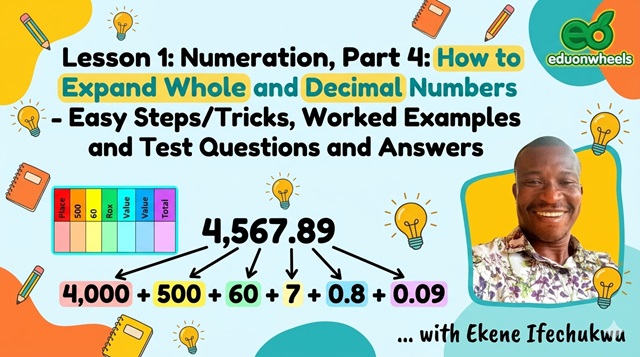
Lesson 1: Learn how to expand whole and decimal numbers using easy steps, tricks, worked examples, and test questions — with Ekene Ifechukwu.. Images: 2
The Eduonwheels “Steps/Tricks” Method
Traditional methods can be tedious. Our video lesson introduces a streamlined “trick” that simplifies the process into two actionable steps. Step 1: The Whole Number Trick
To expand a whole number like 4376:
- The Rule: Write the first digit and turn every other following digit into a zero.
- Application:
- Take the 4 (Thousands place) →→ Write 4000.
- Take the 3 (Hundreds place) →→ Write 300.
- Take the 7 (Tens place) →→ Write 70.
- Take the 6 (Ones place) →→ Write 6.
- Step 2: Separate your results with a (+)(+) sign.
- Result: 4000+300+70+64000+300+70+6.
Step 2: The Decimal Number Trick
Decimals often confuse students because of the “invisible” placeholders. To expand 0.6539:
- The Rule: Identify the position of the digit relative to the decimal point.
- 1st digit after decimal (Tenths) →→ 0.60.6
- 2nd digit (Hundredths) →→ 0.050.05
- 3rd digit (Thousandths) →→ 0.0030.003
- 4th digit (Ten-thousandths) →→ 0.00090.0009
- Result: 0.6+0.05+0.003+0.00090.6+0.05+0.003+0.0009.
Reverse Engineering: From Expanded Form to Standard Form
The video also covers the reverse process, which is a common question type in exams like the Kangaroo Math or AMC.
- Question: Write 5000+900+20+15000+900+20+1 as a whole number.
- Solution: Simply align the non-zero digits. The 5 is in the thousands, 9 in hundreds, 2 in tens, 1 in ones.
- Answer: 5921.
Question: Write 0.1+0.004+0.00070.1+0.004+0.0007 as a decimal.
- Solution: Be careful with placeholders!
- 0.1 (Tenths place has a 1)
- 0.004 (Thousandths place has a 4 – note the empty hundredths place!)
- 0.0007 (Ten-thousandths place has a 7)
- Answer: 0.1047.
Global Relevance and Exam Preparation
This lesson is tailored for a diverse audience.
- USA/Canada: Aligns with Common Core State Standards for Number and Operations in Base Ten.
- UK/Europe: Supports the Key Stage 3 National Curriculum for Number.
- Nigeria/West Africa: Directly addresses the Numeration section of JAMB, NECO, and WASSCE syllabi.
- India/Asia: Complements NCERT and CBSE mathematics curriculums regarding place value.
Conclusion
Mathematics should not be about memorization; it should be about understanding patterns. By using the “Steps/Tricks” method provided by Eduonwheels, students can move from confusion to confidence. Whether you are solving for xx in algebra or calculating interest rates in economics, the ability to expand and deconstruct numbers is a skill that lasts a lifetime.
Call to Action
Ready to test your skills? Try the “Test Yourself” questions in our video and let us know your score in the comments! Don’t forget to subscribe to Eduonwheels for more simplified mathematics lessons designed to boost your critical thinking.
Academic Authority & Citations (APA Style)
Reference List:
1. Khan Academy. (n.d.). Decimal place value: Expanded form. https://www.khanacademy.org/math/arithmetic/arith-decimals/arith-review-decimals-intro/v/expanded-form-of-a-decimal
2. Math Is Fun. (2023). Decimals: Expanded form. https://www.mathsisfun.com/numbers/expanded-form.html
3.National Council of Teachers of Mathematics. (2023). Principles and standards for school mathematics: Number and operations. https://www.nctm.org/Standards-and-Positions/Principles-and-Standards/
4. Eduonwheels. (2026). Lesson 1 numeration, part 4: Expansion of whole and decimal numbers – Steps and tricks, worked examples, test questions and answers [Video]. YouTube. https://www.youtube.com/@Eduonwheels
Learn expansion of whole and decimal numbers with easy steps and tricks – Lesson 1, Part 4 by Ekene Ifechukwu. Images: 3
Numeration: How to Do Expansion of Whole and Decimal Numbers – Easy Steps & Tricks, Worked Examples, Test Questions and Answers



0 Comments