Numeration: Comparing Decimal Numbers – Easy Steps & Tricks, Worked Examples, Test Questions & Answers
Numeration: Comparing Decimal Numbers – Easy Steps and Tricks, Worked Examples, Test Questions and Answers
Lesson 1: Numeration, Part 3b
3 Comparing Number
3.1 Comparing Decimal Numbers: Steps and Trick(s), Worked Examples, Test Questions and Answers
How to Compare Decimal Numbers: Easy Steps, Tricks & Practice Questions for Global Exams
Introduction
Comparing decimal numbers is a core numeration skill that appears across every major mathematics curriculum worldwide. Whether you’re preparing for the SATs in the United States, GCSEs in the United Kingdom, CBSE or NCERT exams in India, WASSCE/NECO/JAMB in Nigeria and West Africa, or international assessments like the IB, Cambridge A-Levels, Kangaroo Math, and the IMO, mastering decimal comparison is non-negotiable. At Eduonwheels Global, we believe mathematics should be accessible, logical, and exam-ready. That’s why we’ve developed a Simplified Mathematics approach that breaks down decimal comparison into clear, repeatable steps—delivered with precise British RP narration to ensure clarity for learners across continents.
The Simplified Mathematics Approach: Steps & Tricks
When comparing decimals, students often make the mistake of counting digits or ignoring place value. Our method eliminates guesswork:
- Compare the Whole Parts First: Always start left of the decimal point. The number with the larger whole part is automatically greater.
- Compare Decimal Parts Systematically: If whole parts are equal, move right digit by digit. Compare tenths, then hundredths, then thousandths, until a difference appears.
- Pad with Zeros if Needed: Add trailing zeros to align decimal places. This prevents visual confusion and ensures accurate digit-by-digit comparison.
- Rank or Order as Required: Apply the same logic to arrange numbers in ascending (smallest to largest) or descending (largest to smallest) order.
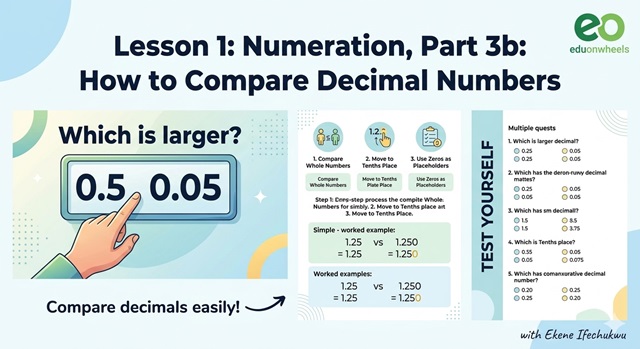
Prepping for SATs, GCSE, or JAMB? Master decimal comparison instantly with these ‘Simplified Mathematics’ tricks. Image: 2
Worked Examples Breakdown
In our video, we demonstrate two comprehensive examples. Example 1 features mixed whole numbers (e.g., 1401.1, 274.6363, 95.67482). By isolating the whole parts, we instantly identify 1401.1 as the largest and 95.67482 as the smallest, then rank the remainder by decimal precision. Example 2 focuses on numbers with identical whole parts (6531.xxxx), requiring careful decimal place comparison. We show how to line up digits, compare sequentially, and correctly order them in both descending and ascending formats. These patterns mirror actual exam questions from GCSE, SAT, and West African senior secondary papers.
Test Yourself: Practice Questions
To reinforce learning, we provide two targeted questions:
- Arrange: 3488.675, 3489.576, 3489.675, 4389.567, 3498.756, 3419.657, 4398.765 in descending and ascending order.
- Identify the smallest and largest: 529.00144, 529.00019, 529.0113, 529.00897. Full answers are provided in the video, with step-by-step reasoning that aligns with marking schemes used in international examinations.
Why This Matters Globally
Decimal comparison isn’t just a classroom exercise—it’s a decision-making tool used in finance, engineering, data analysis, and standardized testing. Students in the US, UK, India, Indonesia, Brazil, Philippines, UAE, Saudi Arabia, Northern Europe, South Africa, and Nigeria all encounter this skill in slightly different formats, but the underlying logic remains identical. Our Simplified Mathematics framework ensures that regardless of your exam board, you can approach these questions with speed, accuracy, and confidence.
Call to Action
Which part of decimal comparison trips you up the most: aligning place values, handling trailing zeros, or ranking large sets of numbers? Drop your answer in the comments below, and our math educators will provide personalized tips!
Academic Reference:
1. Kastberg, S., & Morton, C. (2014). Mathematical content knowledge for teaching elementary mathematics: A focus on decimals. The Mathematics Enthusiast, 11(2), 311–332. https://doi.org/10.54870/1551-3440.1305
2. Van de Walle, J. A., Karp, K. S., & Bay-Williams, J. M. (2018). Elementary and middle school mathematics: Teaching developmentally (10th ed.). Pearson.
3. Khan Academy. (n.d.). Comparing decimals: Place value. Retrieved April 16, 2026, from https://www.khanacademy.org
4. Eduonwheels. (2026). Lesson 1: Numeration – 3.2. How to compare decimal numbers: Steps and tricks [
Video]. Eduonwheels Global Learning Series.
5. National Council of Teachers of Mathematics. (2014). Principles and standards for school mathematics. NCTM.
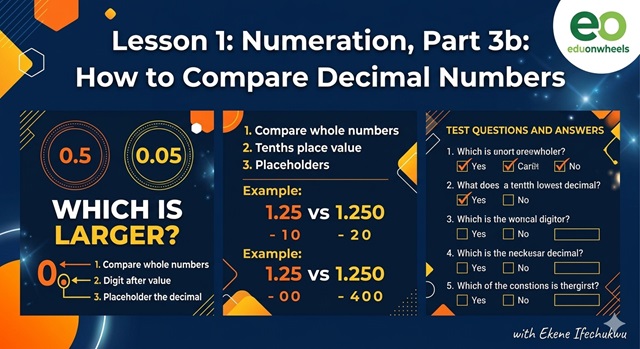
Prepping for SATs, GCSE, or JAMB? Master decimal comparison instantly with these ‘Simplified Mathematics’ tricks. Images: 3
Numeration: Comparing Decimal Numbers – Easy Steps & Tricks, Worked Examples, Test Questions & Answers




0 Comments