No Results Found
The page you requested could not be found. Try refining your search, or use the navigation above to locate the post.

The page you requested could not be found. Try refining your search, or use the navigation above to locate the post.

Numeration: Application of Real-world Maths Problems in Everyday Life – Worked Examples and Test Yourself Questions and Answers (TQAs)
Lesson 1: Numeration, Part 7:
7. Application of Real-world Maths Problems in Everyday Life – Worked Examples and Test Yourself Questions and Answers (TQAs)
| Easy Maths Tricks and Steps | Eduonwheels’ Simplified Mathematics Online Lesson Videos for Critical Thinking, Decision-making and Problem-solving Skills
Numeration: How to Do Counting in Whole Numbers
Numeration: Counting Decimal Numbers – ‘How to’ – Easy Tricks/Steps, Worked Examples, TQAs
Mathematics is often taught as an abstract language of symbols and equations, leaving many students asking a fundamental question: “When am I ever going to use this in real life?” At Eduonwheels, we believe the answer lies in changing how we approach the core foundations of math. By focusing on Numeration: Application of Real-world Maths Problems in Everyday Life, we can transform numbers on a page into practical tools for critical thinking, financial literacy, and confident decision-making.
Whether a student is navigating primary school or preparing for rigorous international examinations like the US Common Core, UK GCSEs, West African WASSCE, or the International Mathematical Olympiad (IMO), mastering whole numbers, decimals, and place-value zeros is the ultimate superpower.
Numeration isn’t just about counting; it is the system we use to break down, organize, and value numbers. In daily life, this system dictates how we interact with money, measurements, time, and data.
Consider a simple trip to the grocery store. If you buy a collection of items, your receipt will feature a mix of whole numbers and decimal values. Understanding how to instantly process these values, align decimal points, and recognize the weight of trailing or leading zeros is what prevents costly errors.
When students learn through Worked Examples, they stop memorizing formulas blindly. Instead, they begin to see the logical flow of mathematics. They understand that a decimal point isn’t just a dot on a whiteboard—it represents the boundary between whole units and fractions of a whole, a concept vital for everything from calculating medication dosages to budgeting a monthly salary.
To truly appreciate the power of practical mathematics, let’s look at how everyday scenarios depend on precision.
Imagine you are managing a small community baking project. You buy $5\text{ kg}$ of flour at $\$2.50$ per kilogram, $2\text{ kg}$ of sugar at $\$1.80$ per kilogram, and a pack of eco-friendly containers for a flat rate of $\$15$.
A structured math approach breaks this down step-by-step:
Identify the whole numbers and decimals: The weight of the flour ($5$) and sugar ($2$), and the cost of containers ($\$15$) are whole numbers. The rates ($\$2.50$ and $\$1.80$) are decimals.
Apply multiplication with decimals:
Align and add: To find the total, you must align the decimal points perfectly, treating the whole number $15$ as $15.00$ to maintain place value:
By analyzing these Worked Examples, students build the analytical frameworks required for higher-stakes problem-solving.
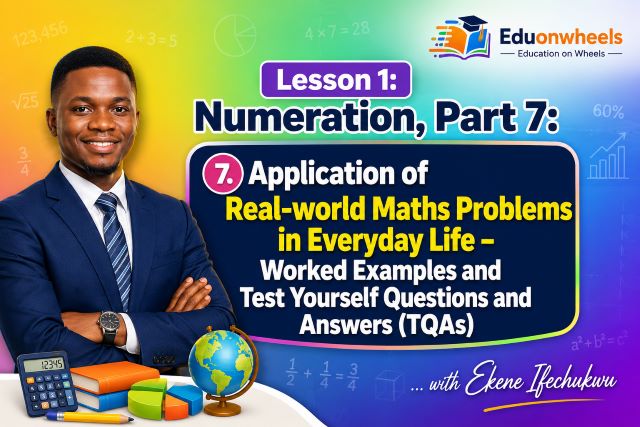
Learn how mathematics is applied in everyday life through practical real-world problems, step-by-step worked examples, and Test Yourself Questions and Answers (TQAs) with Ekene Ifechukwu. Part 7 of the Numeration series by Eduonwheels.
The best way to lock in mathematical fluency is through active retrieval. We encourage educators, parents, and students to use targeted exercises to bridge the gap between watching a lesson and mastering a concept.
Try calculating real-world utility bills, converting sports statistics, or analyzing metric travel distances.
Once you complete these exercises, comparing your work against clear Answers to Test Yourself Questions provides the immediate feedback loop necessary to correct misconceptions about placeholder zeros and decimal alignment before they become bad habits.
We want to build a global community of critical thinkers, and your voice is an essential part of that mission!
💬 What do you think? When introducing young learners or high school students to decimals and large whole numbers, what real-world scenario (like tracking video game currencies, calculating sports stats, or split-second budgeting) have you found triggers that sudden “aha!” moment of complete understanding?
Share your creative teaching tips, personal experiences, or questions in the comment section below—let’s discuss and learn from each other!
Handwriting on a lined chalkboard displaying a practical mathematics worked example titled “Lesson 1: Numeration, Part 7. Application of Real-World Maths Problems in Everyday-Life – Worked Examples, Test Yourself Questions and Answers”. The text shows a grocery shopping list containing items like packs of milk, kilograms of apples, bread, meat, and cheese with their respective decimal and whole-number prices in US dollars, with an answer section highlighting whole versus decimal items below.
SEO Title: Numeration in Everyday Life: Real-World Math Mastery | Eduonwheels
Meta Description: Discover how to apply numeration and real-world math to daily life. Featuring step-by-step worked examples, test questions, and simplified math hacks.
#BasicMaths #HighSchoolMaths #Eduonwheels #Numeration #RealWorldMaths #ProblemSolving #CriticalThinking #STEMEducation #MathTricks
Rahayu, A. P., Putri, R. I. I., & Darmawiyoyo, D. (2018). Learning process of decimals through the base ten strips at the fifth grade. International Journal of Instruction, 11(3), 153–162. https://doi.org/10.12973/iji.2018.11311a
Sowder, J. (1997). Research into practice: Place value as the key to teaching decimal operations. Teaching Children Mathematics, 3(8), 448–453. https://doi.org/10.5951/tcm.3.8.0448
Major, K. (2012). The development of an assessment tool: Student knowledge of the concept of place value. Mathematics Education Research Group of Australasia, 481–488.
Eduonwheels. (2026). Numeration and numerical literacy: Mastering place values, expansion, and structural comparison of whole and decimal numbers in real-world contexts (Global Curriculum Framework Module 4). Eduonwheels Educational Resources.

0 Comments