No Results Found
The page you requested could not be found. Try refining your search, or use the navigation above to locate the post.


The page you requested could not be found. Try refining your search, or use the navigation above to locate the post.

Preparing for JAMB UTME Biology just got easier with Eduonwheels’ Introduction to JAMB UTME Biology Past Questions and Answers 2001 – 2025. This comprehensive resource is designed for students who want to master Biology concepts, practice real exam questions, and boost their chances of scoring high in JAMB.
The JAMB UTME Biology Past Questions and Answers 2001 – 2025 provide over two decades of exam experience, carefully arranged for quick revision and practice. Each question comes with the correct answer, helping candidates understand exam patterns, identify repeated topics, and focus on the most important areas of concentration.
Whether you’re targeting a top score or just aiming to pass with confidence, JAMB UTME Biology Past Questions and Answers 2001 – 2025 gives you the competitive edge. It is not just a study material—it’s your trusted exam partner.
Eduonwheels makes this collection easily accessible, student-friendly, and market-oriented, ensuring that learners can practice anywhere, anytime. With the right preparation, success in Biology becomes achievable.
Boost your chances of success with Eduonwheels’ JAMB UTME Biology Past Questions and Answers 2001 – 2025. Practicing with real exam questions gives you the edge to score higher, answer faster, and secure admission. Don’t leave your future to chance — start revising with JAMB UTME Biology Past Questions and Answers today and get ahead of the competition!
Start your journey today with Eduonwheels’ JAMB UTME Biology Past Questions and Answers 2001 – 2025 and move one step closer to your admission goals.
JAMB UTME Biology Past Questions and Answers: Repeated Questions 2001 – 2025
JAMB UTME Biology Past Questions and Answers: Topics, including New Topics
JAMB UTME Biology Past Questions and Answers PDF 2001 – 2025
JAMB UTME Biology Past Questions and Answers: Likely Questions 2026 – 2030
Preparatory Tests on JAMB UTME Biology Past Questions and Answers: MCQ
1. An association between the root nodule of a leguminous plants and rhizobium sp is known as
A. commensalism B. mycorrhiza C. parasitism
D. symbiosis
2. Amphibians are normally found
A. on dry land and in water B. in water and on moist land
C. on moist land D. in water
3. Viviparity occurs mainly in the
A. mammals B. reptiles C. aves D. amphibians
4. The jointed structure in insects that bears organs which are sensitive to touch, smell and vibration is the
A. maxilla B. labium C. antenna D. abdomen
5. Which of the following groups is the most advanced?
A. Pteridophytes B. Bryophytes
C. Thallophytes D. Gymnosperms
6. Most monocots are easily recognized by their
A. short leaves with petioles B. long and sword-like leaves C. long and palm-like leaves
D. short leaves with many veinlets
7. Water fleas, wood lice and barnacles belong to the group
A. arachnida B. crustacea C. insecta D. chilopoda
8. The mode of feeding in Amoeba and Hydra is
A. heterotrophic B. holophytic C. autotrophic
D. symbiotic
9. Which of the following organisms does not exist as a single free living cell?
A. Paramecium B. Volvox C. Amoeba
D. Chlamydomonas
Use the diagram below to answer questions 10 and 11
10. The structures labelled II and III respectively are
A. female organs and rhizoid B. male organs and rhizoid C. sporophyte and sori D. annulus and stalk of sporangium
11. In ferns, the structure above is equivalent to the
A. zygote of a moss B. gametophyte generation of a moss
C. sporophyte generation of a moss
D. sporophyte of a moss
12. The centre for learning and memoryin thehuman brain is the
A. medulla oblongata B. cerebellum
C. cerebrum D. olfactory lobe
13. Urea formation occurs in the
A. heart B. liver C. lung D. kidney
Use the diagram below to answer questions 14 and 15
14. The structure that holds the yolk in position is labelled
A. II B. I C. IV D. III
15. The part labelled IV is the
A. albumen B. germinal disc C. sturdy D. stunted
16. The gas produced during tissue respiration can be identified by using
A. calcium hydroxide B. copper sulphate
C. calcium carbonate D. sodium hydroxide
17. A seedling grown in the dark is likely to be
A. etiolated B. dormant C. sturdy D. stunted
18. The enzyme invertase will hydrolyze sucrose to give
A. maltose and glucose B. glycerol and fatty acid
C. glucose and fructose D. mannose and galactose
19. When yeast respires anaerobically, it converts simple sugar to carbon (IV) oxide and
A. oxygen B. acid C. alcohol D. water
20. The transportation of oxygen and carbon (IV) oxide in mammals is carried out by
A. leucocytes B. thrombocytes C. phagocytes
D. erythrocytes
21. The veins of the leaf are formed by the
A. vascular bundles B. cambium cells
C. palisade tissue D. spongy mesophyll
Use the diagram below to answer questions 22 and 23
22. The parts which function together to bring about hearing are labelled.
A. IV, V and VI B. I, II, IV and VI C. I, II, III and IV
D. I, II and IV
23. The part labelled II is the
A. fenestra ovalis B. middle ear canal
C. internal auditory meatus D. ear ossicles
24. When specimen X is mixed with few drops of iodine solution, the appearance of a blue-black colour confirms that X is
A. Galactose B. Starch C. Sucrose D. Glucose
Use the diagram below to answer question 25 and 26
25. The structure above represents a
A. caudal vertebra B. lumbar vertebra
C. thoracic vertebra D. cervical vertebra
26. Blood vessels usually pass through the structure labelled
A. III B. II C. V D. IV
27. Salts and water are absorbed in the roots and transported to the leaves by
A. diffusion through the xylem tissues B. osmosis through the phloem tissues C. diffusion through the phloem tissues D. osmosis through the xylem tissues
28. The number of plant species obtained from a population study of a garden is as follows: Guinea grass (15), Ipomoeas SSP, (5), sida spp (7) and Imperata spp (23) What is the percentage of occurrence of Imperat, q spp?
A. 35% B. 16% C. 46% D. 23%
29. Carbon (IV) oxide content of the atmosphere is least affected by
A. cutting down and clearing of forest B. forest fires
C. burning of fossil fuels D. plant and animal respiration
30. The factor that least affects food shortages in sub- Saharan Africa is
A. flooding B. pests C. mixed-cropping D. drought
31. The epiphytic habitat can best be described as
A. arboreal B. estuarine C. aquatic D. terrestrial
32. The highest percentage of energy in an ecosystem occurs at the level of the
A. secondary consumers B. decomposers
C. producers D. primary consumers
33. The greatest influence on a stable ecosystem in nature is exerted by
A. man B. pollution C. animals D. rainfall
34. A freshwater pond may contain
A. tadpole, water boatman, leeches and crab
B. water beetle, shrimps, water snail and water bug
C. water lily, fish, water scorpion and dragontly larva
D. pond skater, water lily, shark and mosquito larva
36. The hygrometer is used for measuring
A. relative humidity B. specific gravity
C. rainfall D. salinity
37. The distribution of plants in a rain forest in governed mainly by
A. vegetation B. soil types C. amount of sunlight
D. rainfall pattern
38. Both recessive and dominant characters are found
A. on different chromosomes in the cell
B. at the same locus of a homologous chromosome
C. mother’s sex cell D. mother’s X chromosome
39. The probability of a baby being a boy or a girl depends on the condition of the
A. father’s sex cell B. father’s somatic chromosome
C. mother’s sex cell D. mother’s X chromosome
40. Which of the following statements is true of blood groups and blood transfusion?
A. Group O is the universal recipient
B. Group A can donate to group A only
C. Group AB is the universal recipient
1: An association between the root nodule of a leguminous plant and rhizobium sp, is known as
A. commensalism B. mycorrhiza C. parasitism D. symbiosis
2: Amphibians are normally found
A. on dry land and in water B. in water and on moist land C. on moist land D. in water
3: Viviparity occurs mainly in the
A. mammals B. reptiles C. aves D. amphibians
4: The jointed structure in insects that bears organs which are sensitive to touch, smell and vibration is the
A. maxilla B. labium C. antenna D. abdomen
5: Which of the following groups is the most advanced?
A. Pteridophytes B. Bryophytes C. Thallophytes D. Gymnosperms
6: Most monocots are easily recognized by their
A. short leaves with petioles B. long and sword-like leaves C. long and palm-like leaves D. short leaves with many veinlets
7: Water fleas, wood lice and barnacles belong to the group
A. arachnida B. crustacea C. insecta D. chilopoda
8: The mode of feeding in Amoeba and Hydra is
A. heterotrophic B. holophytic C. autotrophic D. symbiotic
9: Which of the following organisms does not exist as a single free living cell?
A. Paramecium B. Volvox C. Amoeba D. Chlamydomonas
10: The centre for learning and memory in the human brain is the
A. medulla oblongata B. cerebellum C. cerebrum D. olfactory lobe
11: Urea formation occurs in the
A. heart B. liver C. lung D. kidney
12: [Description: Diagram showing a cross-section of a bird’s egg with labeled parts] The structure that holds the yolk in position is labelled
A. II B. I C. IV D. III
13: [Description: Same diagram as question 12] The part labelled IV is the
A. albumen B. germinal disc C. chalaza D. yolk
14: The gas produced during tissue respiration can be identified by using
A. calcium hydroxide B. copper sulphate C. calcium carbonate D. sodium hydroxide
15: A seedling grown in the dark is likely to be
A. etiolated B. dormant C. sturdy D. stunted
16: The enzyme invertase will hydrolyze sucrose to give
A. maltose and glucose B. glycerol and fatty acid C. glucose and fructose D. mannose and galactose
17: When yeast respires anaerobically, it converts simple sugar to carbon (IV) oxide and
A. oxygen B. acid C. alcohol D. water
18: The transportation of oxygen and carbon (IV) oxide in mammals is carried out by
A. leucocytes B. thrombocytes C. phagocytes D. erythrocytes
19: The veins of the leaf are formed by the
A. vascular bundles B. cambium cells C. palisade tissue D. spongy mesophyll
20: [Description: Diagram showing parts of the human ear] The parts which function together to bring about hearing are labelled
A. IV, V and VI B. I, II, IV and VI C. I, II, III and IV D. I, II and IV
21: [Description: Same diagram as question 20] The part labelled II is the
A. fenestra ovalis B. middle ear canal C. internal auditory meatus D. ear ossicles
22: When specimen X is mixed with few drops of iodine solution, the appearance of a blue-black colour confirms that X is
A. Galactose B. Starch C. Sucrose D. Glucose
23: [Description: Diagram showing a vertebra] The structure above represents a
A. caudal vertebra B. lumbar vertebra C. thoracic vertebra D. cervical vertebra
24: [Description: Same diagram as question 23] Blood vessels usually pass through the structure labelled
A. III B. II C. V D. IV
25: Salts and water are absorbed in the roots and transported to the leaves by
A. diffusion through the xylem tissues B. osmosis through the phloem tissues C. diffusion through the phloem tissues D. osmosis through the xylem tissues
26: The number of plant species obtained from a population study of a garden is as follows: Guinea grass (15), Ipomoeas spp, (5), sida spp (7) and Imperata spp (23). What is the percentage of occurrence of Imperata spp?
A. 35% B. 16% C. 46% D. 23%
27: Carbon (IV) oxide content of the atmosphere is least affected by
A. cutting down and clearing of forest B. forest fires C. burning of fossil fuels D. plant and animal respiration
28: The factor that least affects food shortages in sub-Saharan Africa is
A. flooding B. pests C. mixed-cropping D. drought
29: The epiphytic habitat can best be described as
A. arboreal B. estuarine C. aquatic D. terrestrial
30: The highest percentage of energy in an ecosystem occurs at the level of the
A. secondary consumers B. decomposers C. producers D. primary consumers
31: The greatest influence on a stable ecosystem in nature is exerted by
A. man B. pollution C. animals D. rainfall
32: A freshwater pond may contain
A. tadpole, water boatman, leeches and crab B. water beetle, shrimps, water snail and water bug C. water lily, fish, water scorpion and dragonfly larva D. pond skater, water lily, shark and mosquito larva
33: The hygrometer is used for measuring
A. relative humidity B. specific gravity C. rainfall D. salinity
34: The distribution of plants in a rain forest is governed mainly by
A. vegetation B. soil types C. amount of sunlight D. rainfall pattern
35: Both recessive and dominant characters are found
A. on different chromosomes in the cell B. at the same locus of a homologous chromosome C. on the mother’s somatic chromosome D. on the mother’s X chromosome
36: The probability of a baby being a boy or a girl depends on the condition of the
A. father’s sex cell B. father’s somatic chromosome C. mother’s sex cell D. mother’s X chromosome
37: Which of the following statements is true of blood groups and blood transfusion?
A. Group O is the universal recipient B. Group A can donate to group A only C. Group AB is the universal recipient D. Group B can donate to group B only
38: Which of the following is likely to encourage inbreeding in plants?
A. Dioecious B. Protandrous C. Monoecious D. Hermaphrodite
39: A tall plant crossed with a dwarf one produces offspring of which half are tall and half are dwarf. What are the genotypes of the parents?
A. TT, TT B. Tt, Tt C. TT, tt D. Tt, tt
40: In man, the ability to roll the tongue is a variation classified as
A. anatomical B. physiological C. structural D. morphological
41: Darwin is considered the first scientist who correctly explained the theory of
A. special creation B. spontaneous generation C. use and disuse D. organic evolution
42: The stem of a typical aquatic plant usually has many
A. air cavities B. intercellular spaces C. water cavities D. water-conducting cells
43: The role of the male adult honey bee is to
A. clean the hive B. ventilate the hive C. mate with the queen D. care for the young
44: The ability of an organism to live successfully in an environment is known as
A. resistance B. competition C. succession D. adaptation
45: The most important adaptation of xerophytes is the ability of the protoplasm to
A. resist being damaged by loss of water B. store sugar and minerals in the vacuoles C. absorb water and swell D. shrink from the cell wall
46: A green snake in green grass is able to escape notice from predators because of its
A. disruptive colouration B. countershading C. warning colouration D. cryptic colouration
47: For heterotrophic organisms, competition is least caused by the inadequacy of A. mates B. space C. light D. nutrients
48. The most important adaptation of xerophytes is the ability of the protoplasm to
A. resist being damaged by loss of water
B. store sugar and minerals in the vacuoles
C. absorb water and swell
D. shrink from the cell wall
49. A green snake in green grass is able to escape notice from predators because of its
A. disruptive colouration B. countershiping C. warning colouration D. cryptic colouration
50. For heterotrophic organisms, competition is leas caused by the inadequacy of
A. mates B. space C. light D. nutrients
1. D – symbiosis Rhizobium bacteria and leguminous plants form a mutually beneficial relationship where both organisms benefit.
2. B – in water and on moist land Amphibians require moisture for their skin respiration and reproduction but can also survive on land.
3. A – mammals Viviparity (giving birth to live young) is the primary mode of reproduction in mammals.
4. C – antenna The antenna is the jointed sensory organ in insects used for touch, smell, and detecting vibrations.
5. A – Pteridophytes Pteridophytes (ferns) are more advanced than bryophytes, thallophytes, and gymnosperms in terms of vascular tissue development.
6. B – long and sword-like leaves Monocots typically have long, narrow leaves with parallel venation.
7. B – crustacea Water fleas, wood lice, and barnacles are all members of the class Crustacea.
8. A – heterotrophic Both Amoeba and Hydra obtain nutrition by consuming other organisms.
9. B – Volvox Volvox exists as a colonial organism, not as a single free-living cell.
10. C – cerebrum The cerebrum is the part of the brain responsible for learning, memory, and higher cognitive functions.
11. B – liver Urea is formed in the liver through the deamination of amino acids.
12. D – III (chalaza) The chalaza holds the yolk in position within the egg.
13. B – germinal disc The germinal disc is where the embryo develops.
14. A – calcium hydroxide Calcium hydroxide (limewater) turns milky in the presence of carbon dioxide.
15. A – etiolated Seedlings grown in darkness become elongated, pale, and weak (etiolated).
16. C – glucose and fructose Invertase breaks down sucrose into its component monosaccharides: glucose and fructose.
17. C – alcohol Anaerobic respiration in yeast produces ethanol (alcohol) and carbon dioxide.
18. D – erythrocytes Red blood cells (erythrocytes) contain hemoglobin which transports oxygen and carbon dioxide.
19. A – vascular bundles Leaf veins consist of vascular bundles containing xylem and phloem.
20. D – I, II and IV The outer ear, middle ear structures, and cochlea work together for hearing.
21. D – ear ossicles The ear ossicles (malleus, incus, stapes) are located in the middle ear.
22. B – Starch Iodine solution produces a blue-black color when starch is present.
23. C – thoracic vertebra The structure shows characteristics of a thoracic vertebra which articulates with ribs.
24. D – IV (vertebrarterial canal) Blood vessels pass through the vertebrarterial canal in cervical vertebrae.
25. D – osmosis through the xylem tissues Water moves through xylem vessels by osmosis and transpiration pull.
26. C – 46% Total plants = 50; Imperata = 23; Percentage = (23/50) × 100 = 46%.
27. D – plant and animal respiration Respiration both releases and consumes CO₂ in a balanced cycle, having minimal net effect.
28. C – mixed-cropping Mixed-cropping actually helps prevent food shortages by diversifying crops.
29. A – arboreal Epiphytes grow on trees, which is an arboreal (tree-dwelling) habitat.
30. C – producers Producers (plants) capture the most energy directly from the sun through photosynthesis.
31. A – man Human activities have the greatest impact on ecosystem stability through agriculture, urbanization, and resource exploitation.
32. C – water lily, fish, water scorpion and dragonfly larva These are all typical freshwater pond organisms (sharks are marine).
33. A – relative humidity A hygrometer measures the moisture content (relative humidity) of air.
34. C – amount of sunlight Light penetration through the forest canopy determines plant distribution at different layers.
35. B – at the same locus of a homologous chromosome Alleles for the same trait occupy the same position (locus) on homologous chromosomes.
36. A – father’s sex cell The father’s sperm determines sex by carrying either X or Y chromosome.
37. C – Group AB is the universal recipient AB blood group has no antibodies against A or B antigens, allowing reception of all blood types.
38. D – Hermaphrodite Hermaphroditic plants have both male and female organs, facilitating self-pollination and inbreeding.
39. D – Tt, tt A 1:1 ratio indicates a cross between heterozygous (Tt) and homozygous recessive (tt).
40. B – physiological Tongue rolling is a functional characteristic controlled by physiological processes.
41. D – organic evolution Darwin’s theory of natural selection explains organic evolution through adaptation and survival of the fittest.
42. A – air cavities Air cavities (aerenchyma) provide buoyancy for aquatic plants.
43. C – mate with the queen The drone’s only function is to mate with the queen bee during the nuptial flight.
44. D – adaptation Adaptation is the ability of organisms to adjust to and survive in their environment.
45. A – resist being damaged by loss of water Xerophyte protoplasm can withstand dehydration without permanent damage.
46. D – cryptic colouration Cryptic coloration (camouflage) allows organisms to blend with their surroundings.
47. C – light Heterotrophic organisms don’t require light for food production, so they don’t compete for it.
48. The most important adaptation of xerophytes is the ability of the protoplasm to
A. resist being damaged by loss of water
49. A green snake in green grass is able to escape notice from predators because of its
D. cryptic colouration
50. For heterotrophic organisms, competition is least caused by the inadequacy of
C. light
1. Which Biology Question Paper Type is given to you? A. Type A B. Type B C. Type C D. Type D
2. Which of the following characterizes a mature plant cell? A. the cytoplasm fills up the entire cell space B. the nucleus is pushed to the centre of the cell C. the cell wall is made up of cellulose D. the nucleus is small and irregular in shape
3. Which of the following is NOT a function of the nucleus of a cell?
A. it controls the life processes of the cell
B. it translates genetic information for the manufacture of proteins
C. it stores and carries hereditary information
D. it is reservoir of energy for the cell
4. The dominant phase in the life cycle of a fern is the?
A. gametophyte
B. prothallus
C. sporophyte
D. antheridium
5. Parental care is exhibited by
A. toads
B. snails
C. earthworms
D. birds
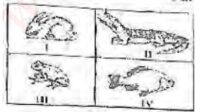
6. With respect to their decreasing dependence on aquatic conditions for reproduction, which of the following is the correct arrangement of the animals represented?
(Diagram shows four animals labeled I, II, III, and IV. I is a lizard, II is a crocodile, III is a frog, and IV is a fish.)
A. I, IV, II and III
B. IV, III, II and I
C. I, II, IV and III
D. III, II, IV and I
7. Which of the animals represents the oldest creatures in terms of evolutionary history?
A. III
B. II
C. I
D. IV
8. Which of the following groups of cells is devoid of true nuclei?
A. algae
B. monera
C. fungi
D. viruses
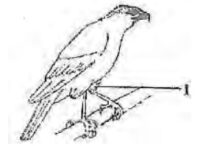
9. The main function of the feathers covering the part labelled I is to
(Diagram shows a bird perched on a branch, with a label I pointing to its wing feathers.)
A. prevent ectoparasites from attacking the animal
B. generate heat to keep the animal warm
C. provide some power for flight
D. serve as insulator to maintain body heat
10. Based on the shape and structure of the beak and feet, the bird represented is likely to feed mainly on
A. flesh
B. fruits
C. seeds
D. nectar
11. Which of the following is true of the transverse section of a dicot system?
A. the epidermis is completely encircled by the cortex
B. the xylem is more interiorly located than the phloem
C. the cambium lies between the cortex and the vascular bundles
D. the vascular bundles are randomly scattered within the cortex
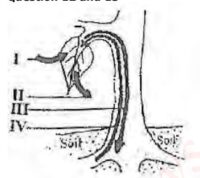
12. The movement of material in the xylem and phloem tissues of the plant are represented by the arrows labelled
(Diagram shows a plant in soil with a curved stem and roots. Arrows labeled I, II, III, and IV show different directions of movement of substances.)
A. III and IV respectively
B. II and I respectively
C. I and II respectively
D. I and III respectively
13. During photosynthesis, the arrow labelled II represents the
A. escape of mineral salts
B. absorption of energy from the sun
C. release of carbon (IV) oxide
D. release of oxygen as a by-product
14. Which of the following is lacking in the diet of a person with kwashiorkor?
A. vitamins
B. proteins
C. carbohydrates
D. —
15. The mode of nutrition of sundew and bladderwort can be described as
A. autotrophic
B. saprophytic
C. holozoic
D. chemosynthetic
16. When the mixture of a food substance and Benedict’s solution was warmed, the solution changed from blue to black-red. This indicates the presence of
A. reducing sugar
B. fatty acid
C. sucrose
D. amino acid
17. The primary structure responsible for pumping blood for circulation through the mammalian circulatory systems is the
A. veins
B. right auricle
C. arteries
D. left ventricle
18. Circulation of blood to all parts of the body except the lungs is through
A. the pulmonary artery
B. systemic circulation
C. the lymphatic system
D. pulmonary circulation
19. Yeast respires anaerobically to convert simple sugar to carbon (IV) oxide and
A. alcohol
B. acid
C. oxygen
D. water
20. The sheet of muscle that separates the thoracic and the abdominal cavities is the
A. diaphragm
B. intercostal muscle
C. pleural membrane
D. pericardium
21. The oily substance that lubricates the mammalian hair to keep it flexible and water repellent is secreted by the
A. sweet glands
B. sebaceous glands
C. fatty cells
D. granular layer
22. The outer layer of the kidney where the Bowman’s capsules are found is the
A. cortex
B. pelvis
C. medulla
D. pyramid
23. Which of the following stimuli is likely to elicit a nastic response in an organism?
A. Touch
B. Light intensity
C. Chemical substances
D. Gravity
24. In the male reproductive system of a mammal, sperm is stored in the
A. van deferens
B. urethra
C. epididymis
D. seminiferous tubules
25. Chemosynthetic organisms are capable of manufacturing their food from simple inorganic substances through the process of
A. oxidation
B. denitrification
C. reduction
D. phosphorylation
26. The part of the human gut that has an acidic content is the
A. stomach
B. duodenum
C. ileum
D. colon
27. Which of the above structures is correctly matched with the organisms in which it is found?
I. Stomata → Spirogyra
II. Alveoli → Earthworm
III. Malpighian tubule → Mammal
IV. Contractile vacuole → Protozoa
A. III
B. II
C. I
D. IV
28. A food chain always begins with a
A. consumer
B. decomposer
C. producer
D. primary consumer
29. Mycorrhizae promote plant growth by
A. absorbing inorganic ions from the soil
B. protecting it from infection
C. helping it to utilize atmospheric nitrogen
D. serving as a growth regulator
30. The barrier between maternal and foetal blood is the
A. placenta
B. liver
C. umbilical cord
D. uterine wall
31. The blood component that has the greatest affinity for oxygen is the
A. lymphocytes
B. leucocytes
C. erythrocytes
D. thrombocytes
32. Which of the following organisms is mainly found in the marine habitat?
A. Achatina
B. Tilapia
C. Dog fish
D. Tortoise
33. The two halves of the pelvic girdle are joined together at the
A. public symphysis
B. ilium
C. pubis
D. obturator foramen
34. Which of the following are ways in which desert animals adapt to extreme heat of the environment?
I. Adoption of appropriate nocturnal habits
II. Burrowing
III. Adjusting their internal body temperature
IV. Possession of many sweat pores
A. I and IV only
B. II and III only
C. I and II only
D. I, II and III only
35. Low annual rainfall, sparse vegetation, high diurnal temperatures and cold nights are characteristic features of the
A. tropical rainforest
B. desert
C. montane forest
D. guinea savanna
36. The activity of an organism which affects the survival of another organism in the same habitat constitutes
A. an edaphic factor
B. an abiotic factor
C. a biotic factor
D. a physiographic factor
37. The average number of individuals of a species per unit area of the habitat is the
A. population density
B. population frequency
C. population size
D. population distribution
38. The vector for yellow fever is
A. Aedes mosquito
B. Anopheles mosquito
C. tsetse fly
D. blackfly
39. The loss of soil through erosion can be reduced by
A. watering
B. crop rotation
C. manuring
D. irrigation
40. The protozoan plasmodium falciparum is transmitted by
A. female Anopheles mosquitoes
B. female Aedes mosquitoes
C. female Culex mosquitoes
D. female blackfly
41. A dilute solution of phenylthiocarbamide tastes bitter to some people and is tasteless to others. This is an example of
A. taste bud variation
B. discontinuous variation
C. morphological variation
D. continuous variation
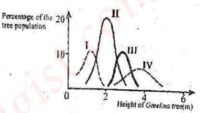
42. In which plantation are all the trees between the height of 2–4m?
(Diagram shows a bar chart representing the percentage of tree population at different heights.)
A. III
B. II
C. I
D. IV
43. Which of the following is a true feature of plantation II?
A. it has the highest number of trees of about 2m high
B. it has highest number of trees
C. it has the highest number of tall trees
D. the height of all its trees range between 2m and 6m
44. Thyroxine and adrenalin are examples of hormones which control
A. blood grouping
B. tongue rolling
C. behavioural patterns
D. colour variation
45. A pair of genes that control a trait is referred to as
A. an allele
B. recessive
C. dominant
D. a hybrid
46. The chromosome number of a cell before and after the process of meiosis is conventionally represented as
A. 2n → 2n
B. n → n
C. n → 2n
D. 2n → n
47. If both parents are heterozygous for a trait, the probability that an offspring will be recessive for that trait is
A. 1/4
B. 1/2
C. 1/4
D. 1
48. At what stage in the life history of a mammal is the sex of an individual set?
A. at adolescence
B. at puberty
C. at birth
D. at conception
49. The main distinguishing features between the soldier termite and other members of the caste are the
A. presence of wings, possession of a small head and large thorax
B. presence of wings, possession of a large thorax and a small head
C. absence of wings, possession of strong mandibles and a large head
D. absence of wings, possession of big head and the absence of mandible
50. The flippers of a whale and the fins of a fish are examples of
A. divergent evolution
B. coevolution
C. continuous variation
D. convergent evolution
1. Which Question Paper Type of Biology is given to you?
A. Type A
B. Type B
C. Type C
D. Type D
2. The function of the red head in male Agama lizards is to
A. conceal and camouflage the animal from predators
B. scare other males from the territory
C. attract female lizards for mating purposes
D. warn predators of the distastefulness of the animal
3. In which of the following species is the biomass of an individual the smallest?
A. Agama sp.
B. Bufo sp.
C. Spirogyra sp.
D. Tilapia sp.
4. Seed plants are divided into
A. tracheophytes and ferns
B. angiosperms and gymnosperms
C. monocotyledons and dicotyledons
D. thallophytes and bryophytes
5. In which of the following groups of vertebrates is parental care mostly exhibited?
A. Reptilia
B. Amphibia
C. Aves
D. Mammalia
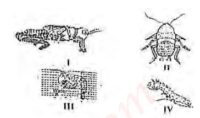
6. Which of the organisms represented are notable agricultural pests?
A. II and IV
B. I and IV
C. II and III
D. I and III
7. An economic importance of the organism represented by IV is that
A. it transmits water borne disease to humans
B. it is destructive to farm crops
C. its faeces pollutes drinking water
D. it helps in the control of mosquito larvae
8. The adult form of III is a vector of
A. sleeping sickness
B. river blindness
C. cholera
D. elephantiasis
9. The adaptive importance of nuptial flight from termite colonies is to
A. disperse the reproductives in order to establish new colonies
B. provide abundant food for birds and other animals during the early rains
C. ensure cross-breeding between members of one colony and another
D. expel the reproductives so as to provide enough food for other members
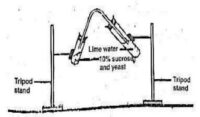
10. The gas evolved in the process is
A. carbon (IV) oxide
B. nitrogen
C. oxygen
D. carbon (II) oxide
11. The experimental set-up above is used to demonstrate the process of
A. diffusion
B. photosynthesis
C. fermentation
D. plasmolysis
12. Which of the following can cause shrinkage of living cells?
A. Hypotonic solution
B. Isotonic solution
C. Deionized water
D. Hypertonic solution
13. Which of the following is true of leucocytes?
A. they are respiratory pigments
B. they are most numerous and ramify all cells
C. they are large and nucleated
D. they are involved in blood clotting
14. The conversion of a nutrient into a molecule in the body of a consumer is referred to as
A. digestion
B. assimilation
C. absorption
D. inhibition
15. The ability of living organisms to detect and respond to changes in the environment is referred to as
A. locomotion
B. irritability
C. growth
D. taxis
16. In mammals, the exchange of nutrients and metabolic products occurs in the
A. lungs
B. oesophagus
C. trachea
D. lymph
17. An example of an endospermous seed is
A. maize grain
B. cashew nut
C. cotton seed
D. bean seed
18. Which of the above modes of nutrition is correctly matched with the organism that exhibits it?
A. II
B. III
C. I
D. IV
19. In which of the test tubes will glucose be detected after complete hydrolysis?
A. I and II only
B. II and III only
C. I only
D. I, II and III
20. The enzyme involved in the hydrolysis is
A. rennin
B. erepsin
C. sucrase
D. maltase
21. The part of the mammalian ear responsible for the maintenance of balance is the
A. cochlea
B. pinna
C. perilymph
D. ossicles
22. The path followed by air as it passes through the lungs in mammals is
A. bronchi → bronchioles → trachea → alveoli
B. bronchi → trachea → alveoli → bronchioles
C. trachea → bronchioles → bronchi → alveoli
D. bronchioles → alveoli → bronchi → trachea
23. The movement response of a cockroach away from a light source can be described as
A. positive phototaxism
B. negative phototaxism
C. negative phototropism
D. positive phototropism
24. The vascular tissues in higher plants are responsible for
A. the movement of food and water
B. suction pressure
C. transpiration pull
D. the transport of gases and water
25. Which of the following organs regulates the levels of water, salts, hydrogen ions and urea in the mammalian blood?
A. Liver
B. Kidney
C. Bladder
D. Colon
26. The sequence of the one-way gaseous exchange mechanism in a fish is
A. operculum → gills → mouth
B. gills → operculum → mouth
C. mouth → operculum → gills
D. mouth → gills → operculum
27. The type of asexual reproduction that is common to both Paramecium and protists is
A. budding
B. sporulation
C. fragmentation
D. fission
28. In nature, plants and animals are perpetually engaged in mutualism because
A. they are rivals
B. all animals rely on food produced by plants
C. they utilize respiratory wastes of each other
D. they are neighbours
29. The percentage of humus in the soil sample is
A. 16.7%
B. 17.6%
C. 26.7%
D. 16.2%
30. An example of a filter-feeding animal is
A. shark
B. butterfly
C. whale
D. mosquito
31. Which of the following is a feature of the population pyramid of a developing country?
A. long lifespan
B. low birth rate
C. low death rate
D. short lifespan
32. The interaction of a community of organisms with its abiotic environment constitutes
A. niche
B. a food chain
C. an ecosystem
D. a microhabitat
33. The vector of the malaria parasite is
A. female Aedes mosquito
B. female Anopheles mosquito
C. male Culex mosquito
D. female Culex mosquito
34. Which of the following instruments is used to measure relative humidity?
A. Hydrometer
B. Thermometer
C. Hygrometer
D. Anemometer
35. Exo-erythrocytic phase of the life cycle of malaria parasite occurs in the
A. liver of humans
B. reticuloendothelial cells of humans
C. Malpighian tubules of mosquito
D. brain of humans
36. Habitats are
A. areas where different plants and animals are found
B. a large community of plants and animals
C. parts of the biosphere
D. specific areas of the environment occupied by an organism
37. The diseases caused by water-borne pathogens include
A. gonorrhoea and poliomyelitis
B. typhoid and syphilis
C. tuberculosis and cholera
D. typhoid and cholera
38. The graph illustrates
A. the highest frequency for height of 2 metres
B. a discontinuously varying character
C. a continuously varying character
D. total yield in a cassava farm
39. The largest number of cassava plants has an approximate height of
A. 1.4m
B. 1.6m
C. 1.8m
D. 2.0m
40. Which of the following is true in blood transfusion?
A. person of blood group AB can donate blood only to another person of blood group AB
B. persons of blood groups A and B can donate or receive blood from each other
C. a person of blood group AB can receive blood only from persons of blood group A or B
D. a person of blood group O can donate only to a person of blood group O
41. A yellow maize is planted and all the fruits obtained are of yellow seeds. When they are cross-bred, yellow seeds and white seeds are obtained in a ratio 3:1. The yellow seed is said to be
A. non-heritable
B. sex-linked
C. a recessive trait
D. a dominant trait
42. When a colour-blind man marries a carrier woman, what is the probability of their offspring being colour blind?
A. 25%
B. 50%
C. 75%
D. 100%
43. The correct base pairing for DNA is
A. adenine → thymine and guanine → cytosine
B. adenine → guanine and thymine → cytosine
C. adenine → cytosine and guanine → thymine
D. adenine → adenine and cytosine → cytosine
44. The type of interaction shown is referred to as
A. interspecific competition
B. intraspecific competition
C. mutualism
D. cooperation
45. Which of the following statement is true of the interaction?
A. P. aurelia is better adapted for obtaining food than P. caudatum
B. P. caudatum is better adapted for obtaining food than P. aurelia
C. both organisms cannot coexist
D. both organisms cannot reproduce
46. The short thick beak in birds is an adaptation for
A. crushing seeds
B. sucking nectar
C. tearing flesh
D. straining mud
47. The basking of Agama lizards in the sun is to
A. change the colour of their body
B. raise their body temperature to become active
C. fight to defend their territories
D. attract the female for courtship
48. The significance of a very large number of termites involved in nuptial swarming is to
A. provide birds with plenty of food
B. ensure their perpetuation despite predatory pressure
C. search for a favourable place to breed
D. ensure that every individual gets a mate
49. The use and disuse of body parts and the inheritance of acquired traits were used to explain
A. Darwin’s theory
B. Lamarck’s theory
C. genetic drift
D. gene flow
50. From his study of Galapagos finches, Darwin derived his theory of evolution from
A. comparative anatomy
B. comparative physiology
C. fossil remains
D. comparative embryology
1. Which Question Paper Type of Biology as indicated above is given to you?
A. Type Green
B. Type Purple
C. Type Red
D. Type Yellow
[Diagram for Q2 & Q3]
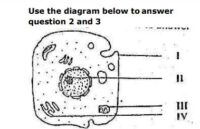
2012 Question Numbers 2 and 3. Images: 1
2. The organelle responsible for heredity is labelled
A. I
B. II
C. III
D. IV
3. The part labelled IV is the
A. mitochondrion
B. cell wall
C. endoplasmic reticulum
D. nucleus
4. Which of the following is most advanced in the evolutionary trend of animals?
A. Liver fluke
B. Earthworm
C. Snail
D. Cockroach
5. Which of the following is the lowest category of classification?
A. Class
B. Species
C. Family
D. Genus
6. Plants that show secondary growth are usually found among the
A. thallophytes
B. pteridophytes
C. monocotyledons
D. dicotyledons
7. The fungi are a distinct group of eukaryotes mainly because they have
A. spores
B. no chlorophyll
C. many fruiting bodies
D. sexual and asexual reproduction
8. An arthropod that is destructive at the early stage of its life cycle is
A. butterfly
B. mosquito
C. bee
D. millipede
9. An animal body that can be cut along its axis in any plane to give two identical parts is said to be
A. radially symmetrical
B. bilaterally symmetrical
C. asymmetrical
D. symmetrical
10. Which of the following possesses mammary gland?
A. Dogfish
B. whale
C. shark
D. catfish
11. The feature that links birds to reptiles in evolution is the possession of
A. feathers
B. beak
C. skeleton
D. scales
12. Countershading is an adaptive feature that enables animals to
A. fight enemies
B. remain undetected
C. warn enemies
D. attract mates
13. Which of the following plant structures lacks a waterproof cuticle?
A. leaf
B. stem
C. root
D. shoot
14. In the mammalian male reproductive system, the part that serves as a passage for both urine and semen is the
A. urethra
B. ureter
C. bladder
D. seminal vesicle
15. In plants, which of the following is required in minute quantities for growth?
A. Copper
B. Potassium
C. Phosphorus
D. Sodium
16. Which of the following organisms is both parasitic and autotrophic?
A. Sundew
B. Loranthus
C. Rhizopus
D. Tapeworm
17. A function of the hydrochloric acid produced in the human stomach during digestion is to
A. neutralise the effect of bile
B. coagulate milk protein and emulsify fats
C. stop the action of ptyalin
D. break up food into smaller particles
18. Which of the following is a polysaccharide?
A. Glucose
B. Sucrose
C. Maltose
D. Cellulose
[Diagram for Q19 & Q20]
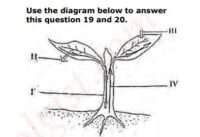
2012 Question Numbers 19 and 20. Images: 2
19. Arrows represent directional movement of materials. Transportation in the xylem is represented by
A. I
B. II
C. III
D. IV
20. The arrow labelled II represents the
A. release of oxygen
B. intake of carbon(IV) oxide
C. movement of photosynthates
D. movement of nutrients
21. In the kidney of mammals, the site of ultrafiltration is the
A. uriniferous tubule
B. Bowman’s capsule
C. loop of Henle
D. renal tubule
22. Which of the following is involved in secondary thickening in plants?
A. Collenchyma and xylem cells
B. Vascular cambium
C. Vascular cambium and cork cambium
D. Cork cambium and sclerenchyma
23. An example of a fruit that develops from a single carpel is
A. okro
B. tomato
C. bean
D. orange
*[Diagram for Q24 & Q25]*
24. The developing embryo is usually contained in the part labelled
A. IV
B. III
C. II
D. I
25. The function of the part labelled III is to
A. produce egg cells
B. protect sperms during fertilization
C. secrete hormones during coitus
D. protect the developing embryo
26. Plant growth can be artificially stimulated by the addition of
A. gibberellin
B. kinin
C. abscisic acid
D. ethylene
27. The autonomic nervous system consists of neurons that control the
A. voluntary muscles
B. heart beat
C. tongue
D. hands
28. Plants of temperate origin can be grown in tropical areas in the vegetation zones of the
A. rain forest
B. Guinea savanna
C. Sudan savanna
D. montane forest
29. The water cycle is maintained mainly by
A. evaporation of water in the environment
B. evaporation and condensation of water in the environment
C. condensation of water in the environment
D. transpiration and respiration in plants
30. Organisms living in an estuarine habitat are adapted to
A. withstand wide fluctuations in temperature
B. survive only in water with low salinity
C. withstand wide fluctuations in salinity
D. feed only on phytoplankton and dead organic matter
31. The presence of stilt roots, pneumatophores, sunken stomata and salt glands are adaptive features of plants found in the
A. tropical rainforest
B. mangrove swamps
C. grassland
D. montane forest
32. Which of the following animals can exist solely on the water they get from food and metabolic reactions?
A. forest arboreal dweller
B. Desert dwellers
C. forest-ground dweller
D. rainforest dwellers
33. The most likely first colonizers of a bare rock are
A. mosses
B. ferns
C. lichen
D. fungi
34. The carrying capacity of a habitat is reached when the population growth begins to
A. increase slowly
B. increase exponentially
C. slow down
D. remain steady
35. The abiotic factors that control human population include
A. disease and famine
B. space and rainfall
C. flooding and earthquake
D. temperature and disease
36. An indigenous method of renewing and maintaining soil fertility is by
A. clearing farms by burning
B. planting one crop type
C. adding inorganic fertilizers yearly
D. crop rotation and shifting cultivation
37. The diseases caused by water-borne pathogens include
A. gonorrhoea and poliomyelitis
B. typhoid and syphilis
C. tuberculosis and cholera
D. typhoid and cholera
[Graph for Q38 & Q39]
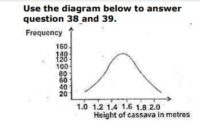
38. The graph illustrates
A. the highest frequency for height of 2 metres
B. a discontinuously varying character
C. a continuously varying character
D. total yield in a cassava farm
39. The largest number of cassava plants has an approximate height of
A. 1.4m
B. 1.6m
C. 1.8m
D. 2.0m
40. Which of the following is true in blood transfusion?
A. A person of blood group AB can donate blood only to another person of blood group AB.
B. Persons of blood groups A and B can donate or receive blood from each other.
C. A person of blood group AB can receive blood only from persons of blood group A or B.
D. A person of blood group O can donate only to a person of blood group O.
41. A yellow maize is planted and all the fruits obtained are of yellow seeds. When they are cross-bred, yellow seeds and white seeds are obtained in a ratio 3:1. The yellow seed is said to be
A. non-heritable
B. sex-linked
C. a recessive trait
D. a dominant trait
42. When a colour-blind man marries a carrier woman, what is the probability of their offspring being colour blind?
A. 25%
B. 50%
C. 75%
D. 100%
43. The correct base pairing for DNA is
A. adenine → thymine and guanine → cytosine
B. adenine → guanine and thymine → cytosine
C. adenine → cytosine and guanine → thymine
D. adenine → adenine and cytosine → cytosine
[Diagram for Q44 & Q45]
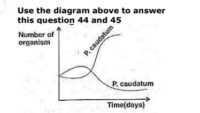
44. The type of interaction shown is referred to as
A. interspecific competition
B. intraspecific competition
C. mutualism
D. cooperation
45. Which of the following statements is true of the interaction?
A. P. aurelia is better adapted for obtaining food than P. caudatum.
B. P. caudatum is better adapted for obtaining food than P. aurelia.
C. Both organisms cannot coexist.
D. Both organisms cannot reproduce.
46. The short, thick beak in birds is an adaptation for
A. crushing seeds
B. sucking nectar
C. tearing flesh
D. straining mud
47. The basking of Agama lizards in the sun is to
A. change the colour of their body
B. raise their body temperature to become active
C. fight to defend their territories
D. attract the female for courtship
48. The significance of a very large number of termites involved in nuptial swarming is to
A. provide birds with plenty of food
B. ensure their perpetuation despite predatory pressure
C. search for a favourable place to breed
D. ensure that every individual gets a mate
49. The use and disuse of body parts and the inheritance of acquired traits were used to explain
A. Darwin’s theory
B. Lamarck’s theory
C. genetic drift
D. gene flow
50. From his study of Galapagos finches, Darwin derived his theory of evolution from
A. comparative anatomy
B. comparative physiology
C. fossil remains
D. comparative embryology
1. C
2. B
3. C
4. D
5. B
6. D
7. B
8. A
9. A
10. B
11. D
12. B
13. C
14. A
15. A
16. A
17. C
18. D
19. A
20. C
21. B
22. C
23. C
24. D
25. D
26. A
27. B
28. D
29. B
30. C
31. B
32. B
33. C
34. C
35. C
36. D
37. D
38. C
39. B
40. D
41. D
42. B
43. A
44. A
45. A
46. A
47. B
48. B
49. B
50. A
1. Which Question Paper Type of Biology is given to you?
A. Type D
B. Type I
C. Type B
D. Type U
2. The process in which complex substances are broken down into simpler ones is referred to as
A. anabolism
B. catabolism
C. metabolism
D. tropism
3. The organ which is sensitive to light in *Euglena* is the
A. gullet
B. flagellum
C. chloroplast
D. eyespot
4. The organelles present in cells that are actively respiring and photosynthesizing are
A. lysosomes and ribosomes
B. Golgi apparatus and endoplasmic reticulum
C. nucleus and centrioles
D. mitochondria and chloroplast
5. *Taenia solium* can be found in
A. cow
B. goat
C. dog
D. pig
[Diagram for Q6 & Q7]
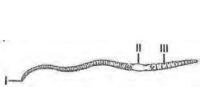
6. The structure labelled II is the
A. spermathecal pore
B. cocoon
C. clitellum
D. chaetae
7. The organism is found in soils rich in
A. mud
B. humus
C. clay
D. sand
8. Which of the following describes a characteristic of arthropods?
A. The organism finds it easy to grow freely
B. the organism has a pair of jointed appendages
C. the body is not divided into a number of segments
D. the body is covered by chitin
9. Which of the following distinguishes a butterfly from a moth?
A. the wings of butterfly rest horizontally but those of moth rest vertically
B. Both are active during the day
C. they have similar antennae
D. the abdomen of moth is fatter than that of butterfly
10. Which of the following types of feathers is used for flight in birds?
A. Quill
B. Filoplume
C. Covert
D. Down
11. The plants that grow in deserts or very dry areas are referred to as
A. mesophytes
B. hydrophytes
C. epiphytes
D. xerophytes
12. Which of the following is the simplest living organism?
A. *Paramecium*
B. Virus
C. *Amoeba*
D. *Chlamydomonas*
13. Proboscis is a structure that is mostly found in
A. insects
B. tapeworms
C. amphibians
D. molluscs
14. The structural adaptation of desert plants for water conservation is
A. broad leaves with numerous stomata
B. spongy mesophyll
C. spiny leaves
D. prominent stomata in leaves
15. The long and sharp clawed feet of birds is an adaptation for
A. crushing seeds
B. scooping mud
C. tearing flesh
D. grasping prey
16. During the manufacture of food by plants, which of the following organism use energy from the sun?
A. *Anabaena*
B. sulphur bacteria
C. *Nitrosomonas* sp.
D. *Nitrobacter* sp.
17. Movement of minerals and chemical compounds within a plant occurs during
A. osmosis
B. translocation
C. transpiration
D. diffusion
18. The enzyme that is present in the saliva is
A. rennin
B. lipase
C. pepsin
D. ptyalin
19. Plants that have special devices for trapping and digesting insects are
A. carnivorous
B. symbiotic
C. parasitic
D. saprophytic
20. The process of transforming the chemical energy of cellular fuels into the high energy bonds of ATP in plants is
A. autotropism
B. photosynthesis
C. photolysis
D. respiration
21. Fungi are referred to as heterotrophs because they
A. are filamentous
B. lack chlorophyll
C. have mycelium
D. lack roots
22. An example of a parasitic protozoan is
A. Paramecium
B. Plasmodium
C. Euglena
D. Chlamydomonas
23. Which blood cells are involved in the immune response of vertebrates?
A. Phagocytes
B. lymphocytes
C. erythrocytes
D. monocytes
24. The blood circulatory system of vertebrates consists of
A. heart, arteries, capillaries and veins
B. heart, aorta, capillaries and veins
C. heart, aorta, arteries and veins
D. heart, vena cava, arteries, and veins
25. A plant tissue that carries water and mineral salts is the
A. cambium
B. xylem
C. cortex
D. phloem
26. Which of the following helps in the clotting of blood?
A. Red blood cells
B. White blood cells
C. Plasma
D. Platelets
27. Which of the following forms about 55% of the volume of the blood in man?
A. leucocytes
B. platelets
C. plasma
D. erythrocytes
28. The part of the mammalian skin involved in excretion is the
A. sweat glands
B. Malpighian layer
C. sebaceous gland
D. horny layer
29. Which of the following is a waste product of an insect?
A. Alkaloids
B. Uric acid
C. Sweat
D. Mucilage
30. The main structure in vertebrates that supports and protects the body is the
A. skeleton
B. ligament
C. muscle
D. joint
31. The chitin in the exoskeleton of many arthropods is strengthened by
A. lipids
B. proteins
C. calcium compounds
D. organic salt
32. The transfer of pollen grains from the anther to a stigma is
A. propagation
B. placentation
C. pollination
D. fertilization
33. The male reproductive organ of a flower is the
A. carpel
B. stamen
C. petal
D. sepal
34. The gland that is found just below the hypothalamus is the
A. parathyroid
B. adrenal
C. pituitary
D. thyroid
35. The most important plant hormone is
A. cytokinin
B. abscisic acid
C. auxin
D. gibberellin
36. The sensory cell that responds to dim light is referred to as the
A. cone
B. lens
C. rod
D. iris
37. The absence of anti-diuretic hormone in humans results in
A. decreasing dehydration
B. drastic dehydration
C. eliminating dehydration
D. increasing dehydration
38. Oestrogen is a hormone that is synthesized in the
A. ovaries
B. testes
C. anterior pituitary
D. adrenal cortex
39. The eye defect caused by the development of cloudy areas in the lenses is
A. presbyopia
B. glaucoma
C. cataract
D. astigmatism
40. A pollutant that is biodegradable is
A. crude oil
B. heavy metals
C. cellophane
D. sewage
41. A tropical disease caused by *Trypanosoma* is
A. sleeping sickness
B. river blindness
C. yellow fever
D. malaria
42. The solid part of the ecosystem is referred to as the
A. atmosphere
B. hydrosphere
C. biosphere
D. lithosphere
43. Which of the following is caused by *Treponema pallidum*?
A. Gonorrhoea
B. Leprosy
C. Tuberculosis
D. Syphilis
44. To which blood group do universal recipients belong?
A. B
B. A
C. O
D. AB
45. The clumping together of red blood cells is
A. agglutination
B. fusion
C. transfusion
D. compatibility
46. Physiological adaptation to very dry conditions in animals demonstrates
A. rejuvenation
B. xeromorphism
C. hibernation
D. aestivation
47. One of adaptation of *Cactus opuntia* to conserve water is the reduction of
A. internodes
B. stem to leaves
C. leaves to spine
D. flower size
48. Which of the following structure is adapted for feeding in a bird of prey?
A. Hooked beak and sharp claws
B. Smooth beak and strong claws
C. Big beaks and strong feet
D. Pointed beak and strong claws
49. The special pigment for colour change in chameleon is
A. melanin
B. carotenoid
C. chromatin
D. chromatophore
50. The behavioural adaptation in social insects could best be described as
A. symbiosis
B. saprophytism
C. parasitism
D. commensalism
1. C
2. B
3. D
4. D
5. D
6. C
7. B
8. D
9. A
10. A
11. D
12. C
13. A
14. C
15. D
16. A
17. B
18. D
19. A
20. D
21. B
22. B
23. A
24. A
25. B
26. D
27. C
28. A
29. B
30. A
31. C
32. C
33. B
34. C
35. C
36. C
37. B
38. A
39. C
40. D
41. A
42. D
43. D
44. D
45. A
46. D
47. C
48. A
49. D
50. A
1. Which Question Paper Type of Biology is given to you?
A. Type F
B. Type E
C. Type L
D. Type S
Diagram for Q2 & Q3
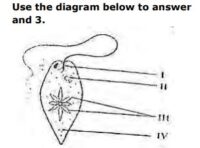
2. The part labelled II is the
A. nucleus
B. eyespot
C. basal granule
D. contractile vacuole
3. The part responsible for photosynthesis is labelled
A. III
B. IV
C. I
D. II
4. The lowest level of organization in living organisms is
A. organ
B. cell
C. system
D. tissue
5. Which of the following is the most complex according to their cellular level of organization?
A. Heart
B. Hair
C. Euglena
D. Hydra
[Diagram for Q6 & Q7]
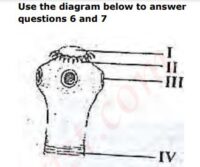
6. The organs for attachment to the lining of the host’s intestine are labelled
A. II and III
B. III and IV
C. I and II
D. I and III
7. The young proglottid is represented by
A. III
B. IV
C. I
D. II
8. Which of the following organisms is multi-cellular?
A. Chlamydomonas
B. Spirogyra
C. Amoeba
D. Euglena
9. In bryophytes, sex organs are produced in the
A. protonema
B. sporophyte
C. gametophyte
D. rhizoid
10. Seed plants are the most dominant vegetation on land because of
A. their motile gametes
B. their ability to photosynthesize
C. efficient seed dispersal
D. availability of water
11. Which of the following is an arboreal organism?
A. Elephant
B. Fish
C. Antelope
D. Bird
[Diagram for Q12 & Q13]
12. The part labelled I is the
A. xylem
B. phloem
C. root hairs
D. cortex
13. The diagram is the transverse section of a
A. monocotyledonous stem
B. dicotyledonous stem
C. monocotyledonous root
D. dicotyledonous root
14. I 2⁄1, C 0⁄0, PM 3⁄2, M 3⁄3.
The general formula above represents that of
A. an omnivore
B. a detritus feeder
C. a carnivore
D. a herbivore
15. A circulatory system is very essential in mammals but not in smaller organisms like Amoeba because
A. Amoeba lives in freshwater
B. diffusion is sufficient to transport materials in Amoeba
C. Amoeba lacks blood containing haemoglobin
D. Amoeba exhibits anaerobic respiration
16. In vascular plants, the sieve tubes and companion cells are present in the
A. cambium
B. cortex
C. xylem
D. phloem
17. The stomata of leaves are similar in function to the
A. pharynx of humans
B. scales of fish
C. spiracle of insects
D. trachea of toads
18. The use of moist skin for respiration in amphibians is known as
A. cellular respiration
B. cutaneous respiration
C. buccal respiration
D. pulmonary respiration
19. Water in plants is removed as water vapour through the process of
A. diffusion
B. osmosis
C. evaporation
D. transpiration
20. An example of an organ of perennation in plants is
A. rhizome
B. seed
C. petal of a flower
D. calyx of flower
21. Alternation of generation is a feature shown in
A. mosses
B. fungi
C. grasses
D. conifers
22. I. Growth is mainly apical
II. Growth is specific with definite shape
III. Growth is throughout life.
Which of the above correctly describes the growth pattern in plants?
A. I, II and III only
B. II and III only
C. I and II only
D. I and III only
23. Coordination and regulation of body activities in mammals are achieved by the
A. nerves and muscle
B. nerves and hormones
C. nerves only
D. hormones only
24. The Cerebellum of the Brain controls
A. reflex action
B. muscular activity
C. emotional expressions
D. the Endocrine system
25. The part of the brain responsible for peristalsis is the
A. Olfactory Lobe
B. Medulla Oblongata
C. Hypothalamus
D. Thalamus
26. Which of the following instruments is used for measuring atmospheric pressure?
A. Hydrometer
B. Hygrometer
C. Thermometer
D. Barometer
27. The influence of soil on organisms in a habitat is referred to as
A. edaphic
B. physiographic
C. biotic
D. topographic
28. The genetic make-up of an organism is described as
A. allele
B. chromosome
C. phenotype
D. genotype
29. The major limiting factor of productivity in the aquatic habitat is
A. food
B. temperature
C. water
D. sunlight
30. Which of the following group of organisms feeds directly on green plants?
A. Primary Consumers
B. Secondary Consumers
C. Producers
D. Decomposers
31. A characteristic feature of tropical rainforest is that it
A. contains trees with narrow leaves
B. contains large number of plant species
C. contains fewer number of plant species
D. has total annual rainfall of less than 50cm
32. The study of how and why population size change over time is
A. Population estimation
B. Population dynamics
C. Population ecology
D. Population Cycle
33. A severe and long dry season is a characteristic feature of
A. Sahel Savanna
B. Mangrove Swamps
C. Sudan Savanna
D. Guinea Savanna
34. Which of the following is a nitrogen-fixing blue-green algae of soil?
A. Rhizobium
B. Nitrosomonas
C. Clostridium
D. Anabaena
35. The soil with highest water-retaining capacity is
A. Clayey Soil
B. Stoney soil
C. Sandy soil
D. Loamy Soil
36. The causative agent of Poliomyelitis is
A. Virus
B. Fungus
C. Protozoan
D. Bacterium
37. One of the ways of controlling noise pollution in urban areas is
A. by siting industries away from residential areas
B. that fuel should be completely combusted by engines
C. by planting trees on both sides of the road
D. by wearing ear devices
38. A constituent of the exhaust fumes from electricity generating sets which causes serious pollution is
A. Carbon(II) Oxide
B. Water Vapour
C. Ozone
D. Carbon(IV) Oxide
39. Which of the following is true of small pox?
A. It is transmitted by bacteria
B. It can effectively be controlled with antibiotics
C. It can effectively be controlled by vaccination
D. It is a water-borne infection
40. A pollutant that is mostly associated with acid rain is
A. Nitrogen(IV) Oxide
B. Ozone
C. Fluorine
D. Sulphur(IV) Oxide
41. When the adults have reached a certain degree of weakness, the process of binary fission is replaced by conjugation in
A. Paramecium
B. Euglena
C. Amoeba
D. Plasmodium
42. Whorls, arches, loops and compounds are types of variation in
A. Colour
B. Finger prints
C. Hair Colour
D. Blood group
43. A couple has 10 children, all female. Which of the following best explains the situation?
A. The sex determination was by the man’s X chromosome
B. The man’s sperm count is low
C. The woman is not capable of producing male children
D. The sex determination was by the man’s Y chromosome
44. A biological agent with antiviral property is
A. Interferon
B. enzyme
C. antibiotic
D. disinfectant
45. One of the advantages of outbreeding is
A. pests tolerance
B. disease resistance
C. fast growth
D. tall height
46. An individual with blood group AB can receive blood from those in blood group(s)
A. A, B, AB, O
B. A, AB and O only
C. AB only
D. A and B only
47. The stream-lined shape of fishes is an adaptation for
A. Securing mates
B. easy movement
C. obtaining food
D. defence and attack
48. An example of a poikilothermic organism is a
A. Lizard
B. Cockroach
C. rabbit
D. bird
49. All living organisms are constantly involved in a struggle for existence. This was proposed by
A. Morgan
B. Darwin
C. Lamarck
D. Wallace
50. Adaptive radiation is illustrated in
A. modified insect mouthparts
B. dentition in mammals
C. wings in birds and bats
D. appendages in insects
1. C
2. D
3. A
4. B
5. B
6. A
7. B
8. B
9. C
10. C
11. D
12. C
13. D
14. D
15. B
16. D
17. C
18. B
19. D
20. A
21. A
22. D
23. B
24. B
25. B
26. D
27. A
28. D
29. D
30. A
31. B
32. B
33. A
34. D
35. A
36. A
37. C
38. D
39. C
40. D
41. A
42. B
43. D
44. A
45. B
46. A
47. B
48. A
49. B
50. B
1. Which of the following has the most primitive respiratory system?
A. insect
B. fish
C. snail
D. mouse
2. One adaptation shown by hydrophytes in fresh water habitats is the
A. waxy cuticle on shoot surface
B. poor development of roots and xylem tissues
C. well-developed roots and supporting system
D. leaves reduced to spines
3. Which of the following use diffusion as the principal method of gaseous exchange?
A. grasshopper
B. rat
C. lizard
D. earthworm
4. The theory which supports the view that the large muscles developed by an athlete will be passed on to the offspring was proposed by
A. Mendel
B. Darwin
C. Lamarck
D. Pasteur
5. The chromosomes of members of the kingdom Monera are within the
A. nucleoplasm
B. nucleus
C. nucleolus
D. cytoplasm
6. The mangrove swamp in Nigeria is restricted to the
A. Sahel savanna
B. Guinea savanna
C. Tropical rainforest
D. Sudan savanna
7. The pancreas secretes enzymes for the digestion of
A. fats, proteins and carbohydrates
B. fats, vitamins and cellulose
C. fats, carbohydrates and vitamins
D. proteins, cellulose and minerals
8. The causative agent of bird flu is a
A. protozoan
B. virus
C. bacterium
D. fungus
9. A water medium is necessary for fertilization in
A. conifers
B. angiosperms
C. ferns
D. fungi
10. An example of a sex-linked trait is the
A. colour of the skin in humans
B. ability to roll the tongue
C. possession of facial hair in adult humans
D. ability to grow long hair in females
11. In which of the following Nigerian states can montane vegetation be found?
A. Bauchi
B. Plateau
C. Taraba
D. Enugu
12. Which of the following is true of cloning?
A. it is welcomed as an ethically and normally sound science
B. it involves the asexual multiplication of the tissues of the original organism
C. the clone is similar to but not exactly like the original organism
D. only one cell of the original organism is needed to initiate the process
13. The process of shedding the exoskeleton of an arthropod is known as
A. ecdysis
B. instar formation
C. metamorphosis
D. osmosis
14. Which of the following is a major cause of constipation in humans?
A. lack of roughage
B. vitamin B
C. vitamin E
D. lack of salts
15. In mammals, the organ directly on top of the kidney is the
A. adrenal gland
B. prostate gland
C. pancreas
D. thyroid gland
16. An accurate identification of a rapist can be carried out by conducting a
A. RNA analysis
B. blood group test
C. behavioural traits test
D. DNA analysis
17. An example of a fish that aestivates is
A. croaker
B. lung fish
C. shark
D. cat fish
18. The opening and closing of the stomata are regulated by
A. respiration
B. osmosis
C. diffusion
D. transpiration
19. Which of the following is common to the mosquito, housefly and blackfly?
A. they are parasites of man
B. their immature stages are aquatic
C. they undergo complete metamorphosis
D. their adults have two pairs of wings
20. The organs that will be most useful to giant African rats in finding their way in underground habitats are the
A. nostrils
B. eyes
C. vibrissae
D. tails
21. A crucible of 5g weighed 10g after filling with fresh soil. It is then heated in an oven at 100°C for 1 hour. After cooling in a desiccator, the weight was 8g. The percentage of water in the soil is
A. 0.8
B. 0.2
C. 0.4
D. 0.6
22. The waste product of plants used in the conversion of hide to leather is
A. alkaloid
B. resin
C. tannin
D. gum
23. The correct sequence of the movement of urea during formation is
A. glomerulus → Bowman’s capsule → convoluted tubule → Henle’s loop → collecting tubule
B. convoluted tubule → glomerulus → Henle’s loop → Bowman’s capsule → collecting tubule
C. glomerulus → Bowman’s capsule → convoluted tubule → Henle’s loop → collecting tubule
D. convoluted tubule → Bowman’s capsule → Henle’s loop → glomerulus → collecting tubule
24. In lizards, the lowering of the gular fold is used to
A. defend their territory
B. attract mates
C. frighten enemies
D. catch insects
25. The photosynthetic pigments include
A. chloroplast and cytochromes
B. melanin and haemoglobin
C. chlorophyll and carotenoids
D. carotenoids and haemoglobin
26. The highest level of ecological organization is the
A. ecosystem
B. niche
C. biosphere
D. population
27. A biotic factor which affects the distribution and abundance of organisms in a terrestrial habitat is
A. pH
B. competition
C. temperature
D. light
28. The eye defect that arises because the cornea is not curved smoothly is
A. astigmatism
B. short-sightedness
C. long-sightedness
D. presbyopia
29. Which of the following is an example of parasitism?
A. a squirrel living in an abandoned nest of a bird
B. mistletoe growing on an orange tree
C. fungi growing on a dead tree branch
D. cattle egrets taking ticks from the body of cattle
30. The increasing order of the particle size in the following soil types is
A. clay → sand → silt → gravel
B. clay → silt → sand → gravel
C. silt → clay → sand → gravel
D. clay → sand → silt → gravel
31. Which of the following factors can bring about competition in a population?
A. emigration
B. drought
C. mortality
D. dispersion
32. Stunted growth and poor root development are a result of a deficiency in
A. phosphorus
B. calcium
C. sulphur
D. iron
[Diagram for Q33 & Q34]
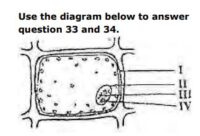
33. The cell organelle solely responsible for respiration is the
A. nucleus
B. nucleolus
C. endoplasmic reticulum
D. mitochondrion
34. The organelle responsible for heredity is
A. IV
B. I
C. II
D. III
[Diagram for Q35 & Q36]
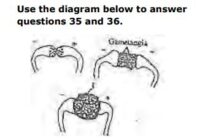
2015 Questions Numbers 35 and 36. Images: 2
35. The process illustrated is
A. gametogenesis
B. sexual reproduction in Rhizopus
C. sexual reproduction in Spirogyra
D. sporulation
36. The structure labelled I is the
A. zygospore
B. conidiophore
C. sporangium
D. hypha
[Diagram for Q37 & Q38]
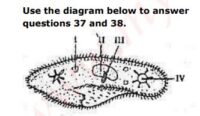
37. The organelle responsible for sexual reproduction is
A. IV
B. I
C. II
D. III
38. The part labelled IV is responsible for
A. respiration
B. ingestion
C. locomotion
D. osmoregulation
[Diagram for Q39 & Q40]
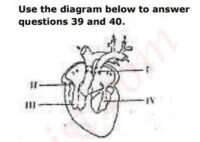
39. The part labelled I is the
A. pulmonary artery
B. bicuspid valve
C. aorta
D. vena cava
40. Oxygenated blood is pumped to the entire body from the part labelled
A. IV
B. I
C. II
D. III
[Diagram for Q41 & Q42]
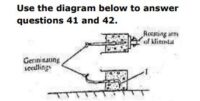
41. The experiment demonstrates
A. hydrotropism
B. phototropism
C. thigmotropism
D. hydrotropism *(Note: Likely typo in original — probably meant “geotropism” or duplicate option)*
42. The part marked I will contain a high concentration of
A. ethylene
B. abscisic acid
C. auxin
D. ascorbic acid
[Diagram for Q43 & Q44]
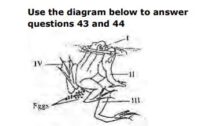
43. The breeding posture illustrated in the diagram is known as
A. reproductive swimming
B. amplexus
C. mating
D. courtship
44. The diagram shows that the organisms are
A. viviparous
B. hermaphrodite
C. ovoviviparous
D. oviparous
45. Insulin is produced by the endocrine organ labeled
A. I
B. IV
C. III
D. II
46. Which of the following will be true of dog II which lost its tail in an accident if it mates with dog III?
A. all its offspring will be born without tails
B. 3/4 of its offspring will be born without tails
C. none of its offspring will be born without a tail
D. 1/4 of its offspring will be born without tails
47. If the dogs are offspring of a monohybrid cross and the gene G for grey head is dominant over allele g, the individual whose genotype is likely to be gg is
A. I
B. IV
C. III
D. II
[Diagram for Q48 & Q49]
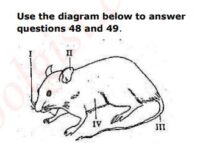
JAMB UTME Past Questions and Answers 2015 Numbers 48 and 49. Images: 7
48. The type of protective adaptation exhibited by the animal is
A. flash coloration
B. countershading colouration
C. warning colouration
D. disruptive colouration
49. The structure labeled I is
A. tactile
B. radiosensitive
C. photosensitive
D. chemoreceptive
50. The structure labelled II represents
A. nucleus
B. nucleolus
C. mitochondrion
D. lysosome
1. A
2. B
3. D
4. C
5. D
6. C
7. A
8. B
9. C
10. C
11. B
12. D
13. A
14. A
15. A
16. D
17. B
18. C
19. C
20. C
21. C
22. C
23. A
24. C
25. C
26. A
27. C
28. A
29. B
30. B
31. B
32. A
33. D
34. D
35. B
36. A
37. D
38. D
39. A
40. B
41. B
42. C
43. C
44. D
45. C
46. C
47. C
48. C
49. B
50. A
1. Which of the following structures is a protective adaptive feature of the Agama Lizard to the environment?
A. Nuchal crest
B. Claws
C. Scaly skin
D. Gular fold
2. Which of the following adapts an insect for feeding?
A. Suitable mouthparts
B. Paired antennae
C. Segmented body
D. Jointed appendages
3. Which of the following results from the cross between Yy and Yy?
A. 2Yy : 2yy
B. 2Yy : yy : YY
C. YY : 2Yy : yy
D. YY : Yy : 2yy
4. Which of the following is NOT part of the carbon cycle?
A. Organic carbon
B. Decomposition
C. Nitrates formation
D. Photosynthesis
5. I. Tissue II. System III. Cell IV. Organ
Which of the above is the level of organization of a leaf?
A. IV
B. I
C. III
D. II
6. In cellular respiration, energy is stored in the form of
A. heat energy
B. adenosine diphosphate
C. adenosine monophosphate
D. adenosine triphosphate
7. The principal organ for the manufacture of food in autotrophs is the
A. root hair
B. growing root
C. mature fruit
D. green leaf
8. A disease that results from lack of iodine in the diet of humans is
A. beriberi
B. scurvy
C. rickets
D. goiter
9. The process whereby organisms with certain favourable features get established in an area is
A. gene mutation
B. dispersal
C. overcrowding
D. natural selection
10. The rise and fall of ocean water during the day is referred to as
A. gravity
B. a pull
C. tide
D. zone
11. Which of the following is a producer in an aquatic habitat?
A. Nymphaea
B. Dryopteris
C. Planarian
D. Simulium
12. The relationship that exists between a shark and Remora is
A. parasitism
B. commensalism
C. saprophytism
D. symbiosis
13. I. Tissue II. System III. Cell IV. Organ
The correct sequence of increasing level of complexity is
A. IV → II → III
B. I → II → III → IV
C. IV → III → I → II
D. III → I → IV → II
14. Which of the following is not an inheritable disease?
A. Poliomyelitis
B. Sickle-cell anaemia
C. Mental illness
D. Haemophilia
15. Which of the fingerprint types occur most frequently in the population of human beings?
A. Double-loop
B. Whorl
C. Arch
D. Loop
16. Beriberi results from a deficiency of
A. vitamin A
B. vitamin E
C. vitamin B
D. vitamin C
17. Bacteria which add atmospheric nitrogen to the soil are
A. putrefying bacteria
B. nitrifying bacteria
C. nitrogen-fixing bacteria
D. denitrifying bacteria
18. The spines of the hedgehog are an adaptive feature for
A. courtship
B. defence
C. water conservation
D. obtaining food
19. The dental formula of carnivores is represented by
A. I 0⁄3, C 1⁄1, PM 4⁄4, M 2⁄3
B. I 0⁄2, C 1⁄1, PM 4⁄4, M 2⁄4
C. I 2⁄3, C 2⁄1, PM 3⁄4, M 2⁄3
D. I 3⁄3, C 1⁄1, PM 4⁄4, M 2⁄2
20. Which of the following instruments is used to measure temperature?
A. Thermometer
B. Hygrometer
C. Anemometer
D. Hydrometer
21. In humans, puffiness and water retention in the body is a possible symptom of
A. bladder malfunction
B. poor digestion
C. kidney malfunction
D. obesity
22. The theory of evolution which postulates that all living organisms have a common ancestor was proposed by
A. Linnaeus
B. Darwin
C. Lamarck
D. Mendel
23. Mammals require roughage in their food to
A. provide energy
B. slow down aging
C. ease digestion
D. prevent disease
24. Variation can occur among offspring of living organisms because
A. seeds are produced by self-pollination
B. zygotes are produced by cross-fertilization
C. they are produced by binary fission
D. they are produced without fertilization
25. The most important biotic factors which affect plants and animals in the habitat are
A. temperature and rainfall
B. temperature and turbidity
C. salinity and relative humidity
D. rainfall and relative humidity
26. The lowest unit of classification is the
A. Kingdom
B. Class
C. Phylum
D. Species
27. Two important processes involved in the absorption and transport of materials in plants are
A. flaccidity and turgidity
B. diffusion and plasmolysis
C. plasmolysis and capillarity
D. osmosis and diffusion
28. A series of organisms existing in an ecosystem through which energy is transformed can be referred to as
A. food cycle
B. food chain
C. pyramid of numbers
D. food web
29. The cell organelle solely responsible for respiration is the
A. nucleus
B. nucleolus
C. endoplasmic reticulum
D. mitochondrion
30. In which part of Nigeria are Mangrove swamps found?
A. Chad Basin
B. Niger Delta
C. Benue Valley
D. Mambilla Plateau
31. The breeding methods that are useful in selective breeding of animals and plants are
A. inbreeding and cross-breeding
B. inbreeding and hetero-breeding
C. inbreeding and out-breeding
D. inbreeding and self-breeding
32. In a small unicellular organism, diffusion is sufficient for transport because
A. the surface area to volume ratio is small
B. they have lungs for diffusion
C. materials have to move over long distance
D. the surface area to volume ratio is large
33. The function of the spinal cord is to
A. stand the body structure erect
B. control involuntary actions
C. transmit impulses to the brain
D. regulate developmental changes
34. The first vertebrates to venture out of water and live on land are the
A. Pisces
B. Amphibians
C. Reptiles
D. Aves
35. Which of the following factors mostly determine the major biomes of the world?
A. pressure and wind speed
B. temperature and wind speed
C. pressure and rainfall
D. temperature and rainfall
36. I. Strong winds II. High temperature III. Dry and porous soils.
Which group of plants are specially adapted to grow under environmental conditions stated above?
A. Thallophytes
B. Mesophytes
C. Xerophytes
D. Hydrophytes
37. The lowest unit of a biogeographical plant species is
A. microflora
B. macrofauna
C. microfauna
D. macroflora
38. Which of the following is a rich source of vitamin K?
A. Tomato
B. Guava
C. Milk
D. Onion
39. Severe diarrhea, dehydration and weakness are symptoms of
A. cholera
B. chickenpox
C. malaria
D. yellow fever
40. A common characteristic found among crustaceans is the possession of
A. a pair of antennae
B. a pair of walking legs on each segment
C. four pairs of walking legs on the cephalothorax
D. two pairs of antennae
41. In which of the following groups of invertebrates are flagella and cilia found?
A. Annelids
B. Protists
C. Coelenterates
D. Arthropods
42. Physiological variation in human population is evidenced in the
A. difference in fingerprints
B. physical appearance of individuals
C. differences in height and weight
D. ability to roll the tongue
43. In photosynthesis, oxygen is liberated during
A. conversion of energy
B. photolysis
C. splitting of carbon(IV) oxide
D. glycolysis
[Table for Q44 & Q45]
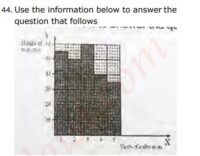
Year | Height of Rice (cm)
2000 | 82
2001 | 79
2002 | 63
2003 | 52
2004 | 63
44. What is the total height of rice that grew within the years of cultivation?
A. 240 cm
B. 239 cm
C. 340 cm
D. 339 cm
45. What is the average of the heights of rice within the period of cultivation?
A. 68 cm
B. 47.8 cm
C. 48 cm
D. 67.8 cm
[Diagram for Q46 & Q47]
46. The type of vertebra represented in the diagram is
A. Atlas
B. Lumbar
C. Axis
D. Sacrum
47. The structure labelled I is the
A. Centrum
B. Neural canal
C. Neural spine
D. Transverse process
1. C
2. A
3. C
4. C
5. A
6. D
7. D
8. D
9. D
10. C
11. A
12. B
13. D
14. A
15. D
16. C
17. C
18. B
19. B
20. A
21. C
22. B
23. C
24. B
25. A
26. D
27. D
28. B
29. D
30. B
31. C
32. D
33. C
34. B
35. D
36. C
37. A
38. D
39. A
40. D
41. B
42. C
43. B
44. D
45. B
46. B
47. B
1. The piercing and sucking mouthparts are found in
A. grasshoppers
B. mosquitoes
C. termites
D. cockroaches
2. The hormones that regulate plant growth are
A. ethylene and auxins
B. auxin and gibberellins
C. cytokinin and abscisic acid
D. ethylene and gibberellins
3. Which of the following pairs of organisms exhibit parasitic association?
A. insect and plant
B. cattle and egret
C. shark and remora
D. tsetse-fly and cattle
4. Which of the following groups of animals can withstand the rigour of arid land?
A. locust, camel, lizard and snakes
B. monkeys, chameleon, earthworm and grasshopper
C. monkeys, grasshopper, snail and snakes
D. lungfish, duck, butterfly and lizards
5. Suture joint is found in the
A. hip
B. ankle
C. skull
D. elbow
6. The organelle responsible for osmoregulation in *Paramecium* is
A. flame cell
B. nephridia
C. contractile vacuole
D. Malpighian tubule
[Diagram for Q7]
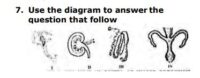
7. The excretory organ of an earthworm is represented by
A. IV
B. I
C. III
D. II
8. The platelets in mammalian blood are responsible for
A. transporting oxygen
B. initiating clotting
C. removing carbon(IV) oxide
D. destroying micro-organisms
9. The most important factor that determines the different types of vegetation is
A. light
B. wind
C. temperature
D. rainfall
10. When testing for the presence of starch in a leaf, the reason for dipping the decolourised leaf in hot water is to
A. detect the starch
B. kill the leaf
C. soften the leaf
D. remove the chlorophyll
11. The relationship between remora and shark can best be described as
A. parasitism
B. amensalism
C. mutualism
D. commensalism
12. The major characteristic of a freshwater habitat is the possession of
A. high turbidity
B. high density
C. low salinity
D. high current
13. The causative organism of cholera is
A. Clostridium sp.
B. Shigella sp.
C. Vibrio sp.
D. Salmonella typhi
14. The process that takes place in the dark stage of photosynthesis is
A. oxidation of water
B. photolysis of water
C. oxidation of carbon(IV) oxide
D. reduction of carbon(IV) oxide
15. Chlorofluorocarbons are air pollutants that originate from
A. crude oil refining
B. coal mining
C. motor vehicle exhaust
D. cooling system
16. Which of the following is organ level of organisation?
A. *Volvox* sp.
B. *Paramecium caudatum*
C. *Hydra viridis*
D. onion bulb
17. The simplest form of reproduction is
A. conjugation
B. budding
C. spore formation
D. binary fission
18. Which of the following is a characteristic of wind-pollinated flowers?
A. flowers lack nectar
B. flowers are conspicuous
C. flowers have perianths
D. flowers are bisexual
[Diagram for Q19]
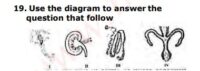
JAMB UTME Past Questions and Answers 2017 Number 19. Images: 2
19. The structure most eminent in terms of water conservation is represented by
A. IV
B. I
C. III
D. II
20. The process required for formation of gametes in sexual reproduction is
A. implantation
B. fertilisation
C. mitosis
D. meiosis
21. In an experiment to determine the humus in a soil sample, the following results were obtained:
Mass of dish = 20g
Mass of dry soil = 7.5g
Mass of dish + soil after burning = 25g
The percentage of humus in the given sample is
A. 9.1
B. 37.5
C. 12.5
D. 33.3
22. The presence of termites and earthworms in soil promotes
A. porosity and fertility
B. porosity and aeration
C. aeration and fertility
D. acidity and aeration
23. In a 15m² habitat, the total number of *Tridax* counted using a 1.6m² quadrant thrown randomly 50 times was 400.
What is the population density of *Tridax*?
A. 12
B. 16
C. 8
D. 5
24. Which of the following is a sex-linked character?
A. Dwarfism
B. Albinism
C. Tongue rolling
D. Colour blindness
25. The outermost tissue of herbaceous roots is the
A. cuticle
B. pericycle
C. epidermis
D. endodermis
26. The respective tissues that transport water and manufactured food in plants are
A. xylem and phloem
B. phloem and tracheid
C. phloem and xylem
D. xylem and tracheid
27. An adaptive feature of plants in the savanna is
A. fissured bark
B. few grasses
C. tall trees
D. long lifespan
28. A grasshopper’s cuticle becomes green during the rainy season and black after fire. The reason for the change is to
A. obtain food
B. avoid predators
C. secure mates
D. escape detection
29. Which of the following is the most advanced plant?
A. Marchantia
B. Dryopteris
C. Chlamydomonas
D. Spirogyra
30. The soil type with the least ability to retain nutrients is
A. sandy loam
B. clay loam
C. loam
D. sand
31. A hummingbird is able to feed on nectar because its beak is
A. short, slender and ridged
B. short, strong and conical
C. long, slender and slightly curved
D. long, wide and slightly curved
[Diagram for Q32]
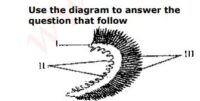
JAMB UTME Past Questions and Answers 2017 Number 32. Images: 3
32. The part labelled III acts as
A. water outlet
B. food strainer
C. exchange surface
D. blood transporter
33. The effect of overcrowding is
A. immigration
B. reduced competition
C. emigration
D. reduced mortality
34. The vertebrae that allow the skull to nod and rotate are
A. axis and cervical
B. atlas and thoracic
C. axis and atlas
D. atlas and cervical
35. The component of the cell that determines paternity resides in the
A. centrosome
B. ribosome
C. nucleus
D. mitochondria
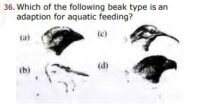
36. Which of the following beak types is an adaptation for aquatic feeding?
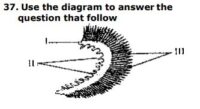
2017 Question Number 37. Images: 5
37. The part labelled II is the
A. arch
B. filament
C. slit
D. raker
38. The insect-trapping by the leaves of Venus flytrap is an example of a
A. adaptive coloration
B. structural adaptation
C. environmental adaptation
D. behavioural adaptation
39. Morphological variation in humans include
A. height, skin colour and tongue rolling
B. weight, fingerprints and body shape
C. height, weight and blood group
D. skin colour, blood and height
40. Which of the following is correct about blood transfusion?
A. Group AB can only receive from groups A and B and not from group O
B. Group O can receive from groups A and B and from AB
C. Group B can only donate to blood group B and not to AB and O
D. Group O can donate to groups A, B and AB but cannot receive
1. B
2. B
3. D
4. A
5. C
6. C
7. C
8. B
9. D
10. C
11. D
12. C
13. C
14. D
15. D
16. D
17. D
18. A
19. D
20. D
21. B
22. C
23. D
24. D
25. C
26. A
27. A
28. D
29. B
30. D
31. C
32. B
33. C
34. C
35. C
36. B
37. D
38. B
39. A
40. D
1. A group of closely related organisms capable of interbreeding to produce fertile offspring are known as members of a
A. kingdom
B. class
C. family
D. species
2. A beaker of pond water containing few specimens of *Euglena* was placed in a dark room for two weeks. At the end of this period, the specimens of *Euglena* were still alive because they were
A. able to carry out holozoic nutrition
B. able to carry out photosynthesis using carbon dioxide in the pond water
C. better adapted to life in darkness than to life in light
D. not overcrowded
3. The cytoplasm of the cell is considered a very important component because it
A. regulates the amount of energy in the cell
B. suspends all cell organelles
C. is the outermost part of the cell
D. is solely responsible for cell division
[Diagram for Q4–Q6]
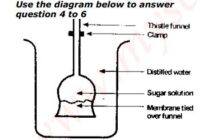
2018 Question Numbers 4 and 6. Images: 1
4. After an hour, the level of water in the thistle funnel will
A. rise
B. fall
C. remain the same
D. double
5. The experiment is used to demonstrate the process of
A. transportation
B. water culture
C. diffusion
D. osmosis
6. In a plant cell, the role of the membrane is played by the
A. nucleolus
B. cell wall
C. cytoplasm
D. mitochondrion
7. Red blood cells were found to have burst open after being placed in distilled water for an hour. This phenomenon is known as
A. plasmolysis
B. diffusion
C. haemolysis
D. wilting
8. The curvature movement of plants in response to the stimulus of water is called
A. hydrotropism
B. geotropism
C. phototropism
D. thigmotropism
9. The overall reaction in glycolysis can be summarised as
A. C₆H₁₂O₆ → 2C₃H₄O₃ + 4H⁺ + ATP
B. C₆H₁₂O₆ → 2C₃H₄O₃ + 4H⁺ + 2ATP
C. C₆H₁₂O₆ → 2C₃H₄O₃ + 4H⁺ + ADP
D. C₆H₁₂O₆ → 2C₃H₄O₃ + 4H⁺ + 2ADP
10. The longest bone in the body is the
A. humerus
B. femur
C. scapula
D. tibia
11. Which of the following structures is not a skeletal material?
A. Chitin
B. Cartilage
C. Bone
D. Muscle
12. The reason why the flow of blood through the capillaries is very slow is
A. because the walls of capillaries are very thin
B. to avoid high blood pressure
C. to ensure that the individual does not get dizzy
D. to allow adequate time for exchange of materials
13. Which of the following groups of organisms has kidney as their excretory organ?
A. Fishes, amphibians, birds, man
B. Fishes, amphibians, annelids, insects
C. Fishes, reptiles, birds, tapeworms
D. Fishes, protozoans, amphibians, man
14. Which of the following features is not a characteristic of arteries? Arteries
A. possess valves at intervals throughout their length
B. have thick muscular and elastic walls
C. carry blood away from the heart
D. transport oxygenated blood with the exception of the pulmonary artery
[Graph for Q15–Q16]
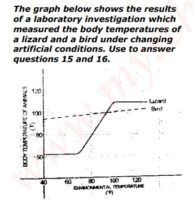
15. Which of the statements below is valid?
A. The bird’s blood was always warmer than that of the lizard.
B. The body temperature of the bird varied less than that of the lizard during changes in environmental temperature.
C. The body temperature of the bird remained constant despite changes in environmental temperature.
D. The body temperature of the lizard was always close to that of the environmental temperature.
16. What physiological term can be used to describe the regulation of the body temperature of the lizard?
A. Homeostasis
B. Homeothermy
C. Poikilothermy
D. Osmoregulation
17. The reason why hospitals use saline solutions as drip instead of water is
A. because salt is a preservative
B. to prevent contamination of the body
C. to maintain the composition of body fluids
D. to increase the number of blood cells
18. The part of the ear which contains nerve cells sensitive to sound vibrations is the
A. cochlea
B. ampulla
C. tympanum
D. malleus
19. Spectacles with convex lenses correct long-sightedness by
A. converging the light rays before they enter the eye
B. diverging the light rays before they enter the eye
C. reducing light intensity before it enters the eye
D. increasing light intensity before it enters the eye
20. A seed of a flowering plant can best be described as
A. radicle and plumule
B. the developed ovule
C. the embryo and endosperm
D. developed ovary
21. Which of the following processes removes carbon from the atmosphere?
A. Putrefaction
B. Photosynthesis
C. Volcanic eruption
D. Burning fuels
22. Which of the following cycles involves the process of precipitation and transpiration?
A. Water cycle
B. Carbon cycle
C. Nitrogen cycle
D. Oxygen cycle
23. What is the critical limiting factor for plants below the photic zone in an aquatic ecosystem?
A. Availability of nutrients
B. Availability of water
C. Intensity of light
D. Carbon dioxide concentration
24. Which of the following instruments is used to estimate the number of plants in a habitat?
A. Pooter
B. Pitfall trap
C. Quadrat
D. Sweep net
25. Which of the following statements is true about sandy soil? It
A. has limited air space
B. is light and easy to dig
C. drains slowly
D. is heavy and poorly aerated
26. Which of the following organisms is a primary consumer?
A. Dog
B. Sheep
C. Grass
D. Fungus
*[Food chain: P → Q → R → S → T for Q27–Q28]*
27. The organism designated P in the food chain above is normally sustained by energy from
A. sunlight
B. carbohydrates
C. green plants
D. mineral salts
28. Which of the following statements best describes the organism designated R? It
A. feeds on S
B. is a primary consumer
C. is a producer as well as a consumer
D. is a secondary consumer
29. Which of the following diseases is not hereditary?
A. Albinism
B. Scabies
C. Haemophilia
D. Colour blindness
30. The immediate product of meiosis in flowering plants is the
A. sporophyte
B. gametophyte
C. zygote
D. pollen grains
31. DNA in eukaryotic cells is contained in the
A. central vacuole
B. nucleus
C. lysosome
D. Golgi body
32. A man who is heterozygous for the disease haemophilia marries a woman who is double recessive for haemophilia. What percentage of their offspring would have the disease?
A. 0%
B. 25%
C. 50%
D. 75%
33. Cytokinesis of mitosis is a process that ensures that
A. each daughter cell gets the necessary organelle
B. there is distribution of a complete set of genes into each daughter cell
C. daughter cells inherit new genetic combinations
D. worn out organelles are excluded from daughter cells
34. An animal which is active during the day is known as a
A. nocturnal animal
B. diurnal animal
C. terrestrial animal
D. homoiothermic animal
35. Evidence of evolution include the following except
A. fossil records
B. comparative anatomy
C. mutation of genes
D. geographical distribution of organisms
[Diagram for Q36–Q37]
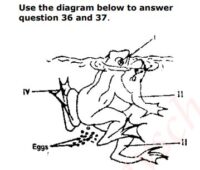
36. The diagram shows that the organisms are
A. hermaphrodite
B. viviparous
C. oviparous
D. ovoviviparous
37. The breeding posture illustrated in the diagram is known as
A. mating
B. amplexus
C. courtship display
D. reproductive swimming
38. An accurate identification of a rapist can be carried out by conducting a
A. RNA analysis
B. DNA analysis
C. blood group test
D. behavioural traits test
39. A boy who is fond of swimming in a pond finds himself passing urine with traces of blood. He is likely to have contracted
A. schistosomiasis
B. onchocerciasis
C. poliomyelitis
D. salmonellosis
40. The flippers of a whale and the fins of a fish are examples of
A. divergent evolution
B. coevolution
C. continuous variation
D. convergent evolution
1. D
2. A
3. B
4. A
5. D
6. B
7. C
8. A
9. B
10. B
11. D
12. D
13. A
14. A
15. C
16. C
17. C
18. A
19. A
20. B
21. B
22. A
23. C
24. C
25. B
26. B
27. A
28. D
29. B
30. D
31. B
32. C
33. B
34. B
35. C
36. C
37. B
38. B
39. A
40. D
In conclusion, Eduonwheels’ JAMB UTME Biology Past Questions and Answers 2001 – 2025 remains an essential tool for every UTME candidate who desires outstanding success. With years of carefully compiled and solved questions, this resource helps students understand exam trends, revise effectively, and build confidence ahead of the test. By practicing with JAMB UTME Biology Past Questions and Answers, you not only gain insight into repeated topics but also improve your speed and accuracy in tackling real exam questions.
Take advantage of Eduonwheels’ JAMB UTME Biology Past Questions and Answers 2001 – 2025 today and position yourself for higher scores and admission success. Your journey to excelling in Biology starts here!

0 Comments