No Results Found
The page you requested could not be found. Try refining your search, or use the navigation above to locate the post.


The page you requested could not be found. Try refining your search, or use the navigation above to locate the post.

Looking to ace the Use of English section of the JAMB UTME? If you’re studying in Nigeria and targeting universities like UNILAG, OAU, ABU, or UI, then focused preparation is key.
Eduonwheels is here to help! Get immediate access to the Eduonwheels JAMB UTME English Language (Use of English) Past Questions and Answers Free 2018. This essential resource provides a realistic simulation of the actual exam, allowing you to:
Don’t wait! Start your free access now and take a significant step towards achieving your highest possible JAMB score and securing your admission in 2024, 2025, 2026 or beyond. Success in the JAMB UTME starts with quality past questions!

Ready to ace the Use of English paper? Download your free JAMB UTME English Language Past Questions and Answers for 2018 and boost your exam preparation today! Images: 1
Questions: Numbered 1 – 100
Read each passage carefully and answer the questions that follow
PASSAGE A
The approach to the University is being restructured to ease the flow of traffic, give better security and provide an appropriate introduction to a seat of higher learning. The Works and Services Complex is also under construction, and we intend to move into the completed (major) part of it within the next few weeks.
All these projects are being executed with an eye to aesthetics for we recognize the important influence of a beautiful and healthy environment of its inhabitants and feel that a cluster of buildings on a small space such as we have should be so well designed as to have a beneficial psychological and sociological effect on all members of the community.
I have gone to these lengths to itemize these examples of current development for two main reasons. Firstly, to advise you that the road diversions and other physical inconveniences currently being experienced will be on the increase because of intense development activity. We therefore appeal to you to bear with us in full knowledge and consolation that such inconveniences are temporary and will soon yield final tangible results. Secondly, to demonstrate our capacity for executing approved projects with dispatch, and to assure Government that we are up to the task. Indeed, I can assure Government that its ability to disburse funds to us will be more than matched by our capacity to collect and expend them on executing various worthy projects in record time.
Questions: 1 – 5:
1. From the passage we can gather that
A. there is not much consideration for the health of the inhabitants
B. there is deliberate effort to inconvenience the people
C. buildings are put up anyhow
D. projects are carried out without approval
E. the inconveniences suffered by the inhabitants will be for a while
2. Unless it can be shown that the money voted for projects can be spent on them in good time
A. the development activity will not be intense
B. it will not be easy to convince the Government of our executive ability
C. it will not be difficult to ask Government for funds
D. our final results will be unreliable
E. the road diversions and other inconveniences will continue
3. (An eye for aesthetics) in this passage means
A. regard for space
B. beneficial psychological effects
C. regard for health
D. consideration for beauty
E. a cluster of buildings alone
4. In this passage the author tries to explain why
A. it is necessary to establish the Works and Services Complex in the University
B. beauty should not be taken into consideration when building on such a small space as we have
C. the gateway to the University is being rebuilt
D. a major part of the project should be completed in the next few weeks
E. visitors should be debarred from using the gates in the meantime
5. Which of these is NOT among the reasons given by the author for enumerating the examples of the current development?
A. To show that we are capable of executing approved projects
B. To convince the Government that we can be trusted with the task
C. The inconvenience currently being experienced will go on indefinitely
D. We are fully aware of the inconveniences being caused but we do not want to complain
E. We have the capacity to complete worthy projects within the scheduled time
PASSAGE II
By the time a child has reached the age of two years, the psychologist says that he is ‘self-conscious’. This is not the same as the lay use of term, although there is a connection. The psychologist means that the child is aware that he is a self and not an extension of his mother. This awareness is shown in such behavioural acts as disobedience and the use of the word ‘no’ with emphasis, because the child is aware that he does not have to obey parental commands.
Parental commands (moral imperatives) are given throughout these two years first for the child’s own safety e.g. ‘Don’t touch the fire’ and secondly, so that he begins to develop some sense of right and wrong. An adult is able to weigh the consequences of his actions partly because he has developed a concept or idea of time. The young child lacks this concept and is governed by immediate desires which must be fulfilled. Thus, in some situations, he can be excused for not behaving morally, i.e making the choice which is ‘good’ for himself and others. In other situations, he knows what is right and chooses not to do it. Immature adults can also behave in this self-centred way.
Questions: 6 – 10:
6. The immature adult is like the child because
A. he has just become self-conscious
B. he has learnt to use the word ‘no’
C. he has no concept of time
D. some of his actions are deliberately irrational
7. What main difference is mentioned between the child and the adult?
A. Age difference
B. Weight difference
C. Time Difference
D. Developmental Difference
8. What right has the mother to give orders to the child?
A. She is the ‘owner’ of the child
B. She is stronger than the child
C. She understands the environment better than the child
D. She is more self-conscious than the child
9. The two-year old child begins to refuse orders
A. in order to annoy his parents
B. because he does not understand them
C. to assert his independence
D. because he has just learnt the new word ‘no’
10. What kind of awareness does the child demonstrate at two?
A. That he does not love his mother
B. Consciousness of all things around him
C. That he should think of himself alone
D. That he is different and separate from others
PASSAGE III
Time was when boys used to point toy guns and say ‘Bang!’. Now, they aim real guns and shoot one another. Nearly 4,200 teenagers were killed by firearms in 1990. Only motor vehicle accidents kill more teenagers than firearms and the firearms figures are rising. The chance that a black male between the ages of 15 and 19 will be killed by a gun has almost tripled since 1985 and almost doubled for white males, according to the National Centre for Health Statistics.
Who could disagree with Health and Human Services Secretary, Donna Shalala, when she pronounced these statistics ‘frightening and intolerable’? In the shameful light of this ‘waste of young lives’ in Ms. Shalala’s words, an often-asked question seems urgently due to be raised again: Would less violence on television – the surrounding environment for most children and young adults – make violence in actual life less normal, less accepted, less horrifying?
It may be difficult to prove an exact correlation between the viewer of fantasized violence and the criminal who acts out violence after turning off the set. But if the premise of education is granted – that good models can influence the young – then it follows that bad models can have an equivalent harmful effect. This is the reasonable hypothesis held by 80 per cent of the respondents to a recent Times Mirror poll who think that violent entertainment is ‘harmful to society’. Witness enough mimed shootouts, see enough ‘corpses’ fall across the screen, and the taking of a human life seems no big deal. Even if a simple causal relationship cannot be established between watching violence and acting it out, is not this numbed sensitivity reason enough for cutting back on the overkill in films and TV?
From: The Christian Science Monitor, April 16-22, 1993, p. 20, CSPS, Boston, MA, USA.
Questions: 11 – 15:
11. From the passage, it can be inferred that since 1985
A. more black males between the ages of 15 and 19 have been getting killed by guns
B. more white than black males have been getting killed by guns
C. more black males between the ages of 15 and 19 have been killing one another with guns
D. more black than white males have been killing one another with guns
12. In Secretary Donna Shalala’s view, the situation depicted by the statistics is
A. disturbing and conducive
B. topical and intimidating
C. tense and reassuring
D. alarming and unbearable
13. The writer says ‘the firearms figures are rising’ because
A. more teenagers are now getting killed by firearms than by motor vehicle accidents
B. more teenagers now carry firearms than used to be the case
C. more teenagers are now getting killed by firearms than used to be the case
D. firearms now have figures that are terribly high
14. What will actually be proved ‘if the premise of education is granted’?
A. Violence on television encourages violence in the real life
B. Good models can influence the young
C. Entertainment on television is harmful to society
D. The viewer of fantasized violence is the criminal who acts out violence
15. The writer uses (numbed sensitivity) to refer to
A. heartlessness on the part of actors
B. deadening of the capacity to feel
C. objectionable behaviour
D. unreasonable violence
PASSAGE IV
The passage below has gaps numbered 16 to 25. Immediately following each gap, four options are provided. Choose the most appropriate option for each gap.
Drought is a word that invokes strong emotions. This is not surprising as the …..16…. is usually accompanied by a number of unpleasant developments. These developments have …..17…. for all citizens, starting from the peasant farmers to the state and federal governments which may be plunged into emergency and crisis situation which, if not successfully …..18…. could result in social unrest.
The timeliness of the onset of the rains in various regions of the country and their adequate distribution thereafter have become …..19…. of considerable anxiety to all people. The fact, however, is that periodic drought in the normal …..20…. of rainfall in the country is not new.
Since large areas of the country are drought prone, the consequences are …..21…. Dry spells could be very severe. There are two aspects of coping with drought. One has to do with emergency measures and the other with …..22…. measures. An immediate consequence of any drought would be famine. In addition, where whole populations are forced to abandon their lands or pastures in search of food, there are bound to be other lasting and …..23…. consequences such as distress, sales of cattle by livestock owners in order to buy food.
Government should provide farmers with agricultural inputs and ensure that they have easy access to these inputs under the relief …..24…. Emergency measures will be much more …..25…. if a mechanism is established to ensure adequate preparedness and defence against the occurrence of drought.
16. A. ideology B. phenomenon C. idea D. component
17. A. feedback B. results C. implications D. outcomes
18. A. managed B. manipulated C. examined D. studied
19. A. object B. subjects C. issues D. topics
20. A. amount B. supply C. stock D. flood
21. A. effective B. disastrous C. evident D. inevitable
22. A. routine B. organized C. urgent D. delayed
23. A. longitudinal B. objective C. simultaneous D. parallel
24. A. action B. process C. scheme D. plan
25. A. normal B. correct C. idealistic D. effective
LEXIS, STRUCTURE AND ORAL FORMS
In each of questions 26 to 30, select the option that explains the information conveyed in the sentence.
26. In spite of his humble beginning, Audu now throws his weight around
A. Audu is arrogant despite his simple upbringing
B. Despite his obvious poverty, Audu is a proud man
C. His noble birth notwithstanding, Audu is a proud man
D. From his poor background, Audu is now a rich man
27. Ngozi has always considered her father to be an impassioned man
A. Her father is a very lively man
B. Her father is an emotional man
C. Her father is a disciplined man
D. Her father is a very strict man
28. The elders rebuked Olu for taking issue with his principal
A. Olu was cautioned for shouting at his principal
B. Olu was scolded for acting in collusion with his principal
C. Olu was reprimanded for arguing with his principal
D. Olu was blamed for issuing a statement denying his principal
29. The manager paid us in hard currency
A. We were paid in new notes
B. We were paid in foreign currency
C. We were paid in dollars and pound sterling
D. We were paid in a strong and stable currency
30. If he went to London, he would see the Queen
A. When he goes to London, he will see the Queen
B. He did not go to London and did not see the Queen
C. He did not see the Queen when he went to London
D. He would like to see the Queen when he goes to London
In each of questions 31 to 50, choose the most appropriate option opposite in meaning to the word(s) or phrase in brackets and italics.
31. Good students can easily identify (spurious) arguments.
A. genuine
B. interesting
C. false
D. illogical
32. Eze’s skin now looks (flabby) as a result of his changed circumstances.
A. neat
B. firm
C. weak
D. oily
33. He and his lieutenants have been accused of remaining (intransigent).
A. rigid
B. stubborn
C. compromising
D. popular
34. In the opinion of most observers, it was a (disinterested) decision.
A. neutral
B. impartial
C. biased
D. candid
35. We watched in wonder as she rattled away in the (esoteric) language.
A. inscrutable
B. familiar
C. secret
D. obscure
36. She was asked to (swallow her pride) and get busy.
A. be more realistic
B. eat up her own pride
C. be more insistent
D. be less proud
37. Many species in creation have (mutated) over the years into new forms of life.
A. stabilized
B. manifested
C. transformed
D. standardized
38. His textile business deals are (in gross).
A. wholesale
B. imported
C. retailed
D. exported
39. The government is (initiating) new effective programmes to (boost) production.
A. ending/enhance
B. reviewing/renew
C. rearranging/increase
D. terminating/reduce
40. The culprit (unwittingly) subjected himself to great humiliation.
A. cunningly
B. curiously
C. foolishly
D. subtly
41. The masses are controlled by the (whims and caprices) of their rulers
A. wish
B. parochialism
C. will power
D. level-headedness
42. In his quest for (solidarity), the party leader undertook a nation-wide tour.
A. unity
B. resistance
C. mobilization
D. re-organisation
43. Our party is (wielding) potent political power
A. assuming
B. renouncing
C. restoring
D. reappraising
44. The ruler expects full (allegiance) from his subjects at all times.
A. obedience
B. homage
C. disloyalty
D. disapproval
45. In spite of many days of fasting, Musa is still (fastidious) about his food.
A. particular
B. undecided
C. indifferent
D. unmindful
46. The leader called for (concerted) efforts in order to get over the problems.
A. combined
B. definite
C. disparate
D. isolated
47. The video tape recorder was made (obsolete) by the introduction of the satellite dish.
A. antiquated
B. useless
C. fashionable
D. functional
48. Segun is somebody who always follows his own (inclinations)
A. impulses
B. aversions
C. dispositions
D. deviations
49. The poor man is compelled to (languish) in his poverty-stricken situation.
A. luxuriate in
B. deteriorate in
C. suffer in
D. laugh at
50. The engineers have been urged to make a (prototype) of the long-awaited Nigerian car
A. specimen
B. original
C. copy
D. drawing
In each of questions 51 to 61, choose the most appropriate option nearest in meaning to the word(s) or phrase in brackets and italics.
51. The commander said that the battle would be sustained, total and (relentless)
A. brutal
B. fierce
C. innocuous
D. continuous
52. His loss suddenly became (redeemable).
A. repulsive
B. incurable
C. exclusive
D. recoverable
53. The move to expel the chairman was (sanctioned) by members of the party.
A. opposed
B. supported
C. unleashed
D. initiated
54. After the meeting, I read a (leer) on his face as he looked at the woman
A. bad look
B. satisfying meaning
C. poor smile
D. pleasant disposition
55. The plane has gone (awry)
A. wrong
B. wild
C. well
D. wide
56. Because Jamiu is also easily (offended), he was not considered for the post of head boy.
A. troublesome
B. stubborn
C. docile
D. irritable
57. The witness provided a (monstrous) account of the event
A. shocking
B. verbatim
C. supportive
D. tragic
58. He is a (prolific) writer.
A. an influential
B. a very productive
C. a clever
D. a well-known
59. The chairman advised the participants to follow the (convention) in stating their points.
A. eloquence
B. prudence
C. tradition
D. advice
60. The recommended novel has a (convoluted) theme
A. an attractive
B. a simple
C. a complicated
D. a disgusting
61. The government has announced its (preparedness) for the scheme
A. determination
B. pleasure
C. readiness
D. regret
In each of questions 62 to 64, choose the option that has the same stress pattern as the given word.
62. dovetail
A. proviso
B. jargon
C. simplicity
D. psychiatry
63. apparent
A. paragraph
B. arrested
C. appetite
D. telephone
64. unfair
A. first-class
B. instant
C. insight
D. inside
In each of questions 65 and 66, choose the option that has the stress on the first syllable.
65.
A. mature
B. madam
C. frequent (verb)
D. convict (verb)
66.
A. pronounce
B. prepare
C. provoke
D. insult
In each of questions 67 and 68, choose the appropriate stress pattern from the options. The syllables are written in capital letters.
67. Catholicism
A. catholiCISM
B. cathoLIcism
C. CAtholicism
D. CaTHOlicism
68. genealogy
A. geneaLOgy
B. GEnealogy
C. geNEalogy
D. geneALogy
In each of questions 69 and 70, choose the option that has a different stress pattern from the others.
69.
A. syllabus
B. competent
C. quality
D. represent
70.
A. registration
B. quadruplicate
C. ability
D. revivalist
In each of questions 71 to 80, select the option that best explains the information conveyed in the sentence.
71. The class has fallen in with the teacher’s plans.
A. The class has accepted the plans
B. The class has ignored the plans
C. The class has modified the plans
D. The class has rejected the plans
72. I owe you far less than you owe me
A. I owe you something, but you owe me much more
B. Your debt is not much greater than mine
C. What we owe each other is approximately the same
D. My debt to you is greater than yours to me
73. Ogiri takes after his father; he fawns upon anyone with influence
A. Ogiri, who looks like his father, follows rich and influential people about
B. Ogiri, who always follows his father, tries to act like an influential person
C. Like his father, Ogiri hates influential people
D. Like his father, Ogiri likes to flatter people with influence in society
74. He had hardly spoken when the bell rang.
A. He found it difficult to speak, and then the bell rang
B. The bell rang very soon after he spoke
C. When the bell rang, he was still speaking
D. He spoke in a harsh manner and the bell rang
75. After the war, the victors became increasingly vindictive
A. Repressive measures were taken against those who lost the war
B. Those who won the war became treacherous
C. Vengeful attacks were incessantly carried out on those who lost the war
D. Friendly measures were taken to heal the wounds
76. I think she takes her guardian’s support for granted.
A. She wants her guardian to grant her more support
B. Her guardian has been helping her for a long time, but she does not show enough gratitude
C. She thinks her guardian will no longer support her as he has been doing
D. Her guardian has been helping her for a long time, and she is very grateful to him
77. You are to write a report and give it to the security office.
A. After writing your report, give it to the security office
B. You are writing a report, as the security office directed
C. You have been ordered to write a report, which you will give to security office
D. The report you are writing should be given to the security office
78. The dispute over land acquisition has now come to a head.
A. The problem has now been referred to the headquarters
B. Because of the dispute, land acquisition has now been halted
C. The problem has now been solved
D. The problem has reached crisis proportions
79. In our college, the regulations concerning resit are a grey area.
A. The regulations have often been ignored
B. The regulations are not very clear
C. The regulations have just been revised
D. The regulations are perfectly clear
80. The prefect reeled off names of all the students who broke the library law.
A. The prefect gave an accurate list of the students who broke into the school library
B. The prefect omitted the names of the students who broke into the library
C. The prefect submitted a complete list of the students who stole library books
D. The prefect gave a disjointed list of the students in the law library
In each of questions 81 to 100, choose the option that best completes the gap(s)
81. The brave hunter killed the… in the forest.
A. big spitting black cobra
B. big black spitting cobra
C. black big spitting cobra
D. spitting big black cobra
82. The… robber showed no mercy during the attack.
A. benevolent
B. loquacious
C. senseless
D. ruthless
83. Despite all preparations, the wedding did not
A. come by
B. come off
C. come along
D. come on
84. Olu brought his clothes and those of his…
A. elder brothers
B. senior brother’s
C. senior brother
D. elder brother’s
85. His family hardly misses the news because he goes about with his… radio.
A. pottable
B. pointable
C. portable
D. potable
86. Did you have… when you went to visit the medical doctor?
A. diarrhae
B. diarrhoea
C. diahrea
D. diarrhoea
87. If he… for admission, I am sure he would succeed.
A. had applied
B. will apply
C. has applied
D. applied
88. The investigation Commission has treated all the… submitted to it by the warring factions.
A. protests
B. applications
C. petitions
D. enquiries
89. The police claim that a number of stolen cars… recovered.
A. has been
B. have been
C. have being
D. has being
90. Everybody is allowed to… his view on state matters.
A. show
B. air
C. hear
D. share
91. For beating… his course mate, Agbaji was… from the university.
A. away/sent out
B. on/expelled
C. at/removed
D. up/rusticated
92. The old man was rushed to hospital when his blood pressure dropped to a… level.
A. dangerous low
B. dangerous lowly
C. dangerously low
D. dangerously lowly
93. Until he lost the election, Agbo… to be the student Union President.
A. would have hoped
B. had been hoping
C. has been hoping
D. has hoped
94. … been there to look for her several times without success.
A. He’ll
B. He is
C. He’s
D. Is he
95. He wrote to you,…?
A. hadn’t he
B. wouldn’t he
C. hasn’t he
D. didn’t he
96. Our neighbour was attracted by the… from my mother’s cooking.
A. scent
B. flavour
C. aroma
D. stench
97. The clubs were not… on a solid ethical base.
A. founded
B. funded
C. created
D. found
98. We have been living peacefully here but… hear rumours of war
A. again
B. occasionally
C. eventually
D. slowly
99. I watched him as he… the hole.
A. is digging
B. dugged
C. dug
D. digs
100. Your performance will improve if you… hard.
A. practise
B. would practise
C. practised
D. are practising

Get your JAMB UTME English Language (Use of English) Past Questions and Answers Free 2018! Join thousands of students using Eduonwheels to master Comprehension, Lexis & Structure, Antonyms & Synonyms, and Phonetics for exam success. Images: 2
Answers: Numbered 1 – 100

Ready to ace your JAMB UTME Use of English exam? Eduonwheels provides comprehensive resources for English Language teaching and learning, specifically designed for JAMB students preparing for their exams. Get started with our free 2018 past questions! Images: 3
You will find in our other Use of English Past Questions and Answers:
JAMB UTME English Language (Use of English) Past Questions and Answers: Repeated Questions 2001 – 2025
JAMB UTME English Language (Use of English) Past Questions and Answers: Topics, including New Topics
JAMB UTME English Language (Use of English) Past Questions and Answers PDF 2001 – 2025
JAMB UTME English Language (Use of English) Past Questions and Answers: Likely Questions 2026 – 2030
Preparatory Tests on JAMB UTME English Language (Use of English) Past Questions and Answers: MCQ
Answer Explanations: Numbered 1 – 100
1. E – The passage clearly states that “such inconveniences are temporary and will soon yield final tangible results,” indicating the inconveniences will be for a while.
2. B – The passage mentions demonstrating “our capacity for executing approved projects with dispatch, and to assure Government that we are up to the task,” meaning it will not be easy to convince the Government without demonstrating this ability.
3. D – “An eye to aesthetics” means consideration for beauty, as the passage discusses recognizing “the important influence of a beautiful and healthy environment.”
4. C – The passage begins by explaining that “The approach to the University is being restructured,” which refers to rebuilding the gateway.
5. C – The passage states the inconveniences are “temporary,” not indefinite. This contradicts what is stated in the passage.
6. D – The passage states that immature adults “behave in this self-centred way,” knowing what is right but choosing not to do it, making their actions deliberately irrational.
7. D – The passage discusses developmental differences, particularly the adult’s developed “concept or idea of time” that the child lacks.
8. C – The passage mentions parental commands are given “for the child’s own safety,” implying the mother understands the environment better.
9. C – The child’s disobedience and use of “no” demonstrates awareness “that he is a self and not an extension of his mother,” asserting independence.
10. D – The passage states the child “is aware that he is a self and not an extension of his mother,” showing awareness of being different and separate.
11. A – The passage states “The chance that a black male between the ages of 15 and 19 will be killed by a gun has almost tripled since 1985,” indicating more are getting killed.
12. D – Secretary Shalala pronounced the statistics “frightening and intolerable,” which means alarming and unbearable.
13. C – The statement refers to the increasing number of teenagers killed by firearms compared to previous years.
14. B – The passage states “if the premise of education is granted – that good models can influence the young,” this is what would be proved.
15. B – “Numbed sensitivity” refers to becoming desensitized or experiencing a deadening of the capacity to feel after witnessing repeated violence.
16. B – “Phenomenon” is the most appropriate word to describe drought as an observable occurrence.
17. C – “Implications” best describes the consequences or effects that developments have on citizens.
18. A – “Managed” is the most appropriate word for handling a crisis situation.
19. C – “Issues” is the correct word to describe matters of considerable anxiety.
20. B – “Supply” best describes the normal amount of rainfall available.
21. D – “Inevitable” means unavoidable, which fits the context of drought-prone areas having unavoidable consequences.
22. B – “Organised” measures contrasts with emergency measures, referring to planned, systematic approaches.
23. D – “Parallel” means occurring alongside, describing consequences happening simultaneously with famine.
24. C – “Relief scheme” is the standard term for organized relief programmes.
25. D – “Effective” means successful or producing desired results, fitting the context of making emergency measures work better.
26. A – “Throws his weight around” means behaving arrogantly, despite humble beginnings means simple upbringing.
27. B – “Impassioned” means showing strong emotions, thus emotional.
28. C – “Taking issue with” means disagreeing or arguing with someone, thus reprimanded for arguing.
29. D – “Hard currency” refers to a strong and stable currency that maintains its value.
30. B – This is a third conditional sentence expressing an unreal past condition, meaning he didn’t go and didn’t see the Queen.
31. A – The opposite of “spurious” (false, fake) is “genuine” (real, authentic).
32. B – The opposite of “flabby” (loose, soft) is “firm” (tight, solid).
33. C – The opposite of “intransigent” (inflexible, unwilling to compromise) is “compromising” (willing to make concessions).
34. C – The opposite of “disinterested” (impartial, unbiased) is “biased” (prejudiced, partial).
35. B – The opposite of “esoteric” (obscure, known only to specialists) is “familiar” (well-known, common).
36. D – “Swallow her pride” means to humble oneself, so the opposite is “be less proud” (though this seems counterintuitive, the question asks for the opposite action).
37. A – The opposite of “mutated” (changed) is “stabilized” (remained constant).
38. C – “In gross” means wholesale (in large quantities), so the opposite is “retailed” (sold in small quantities to consumers).
39. D – The opposite of “initiating” (beginning) is “terminating” (ending), and the opposite of “boost” (increase) is “reduce” (decrease).
40. A – The opposite of “unwittingly” (unintentionally, unknowingly) is “cunningly” (deliberately, with careful planning).
41. D – The opposite of “whims and caprices” (impulsive, unpredictable behaviour) is “level-headedness” (rational, stable decision-making).
42. B – The opposite of “solidarity” (unity, mutual support) is “resistance” (opposition, refusal to cooperate).
43. B – The opposite of “wielding” (exercising, holding) power is “renouncing” (giving up, abandoning) power.
44. C – The opposite of “allegiance” (loyalty) is “disloyalty” (unfaithfulness).
45. C – The opposite of “fastidious” (very particular, hard to please) is “indifferent” (not caring, unselective).
46. C – The opposite of “concerted” (coordinated, unified) is “disparate” (separate, uncoordinated).
47. D – The opposite of “obsolete” (outdated, no longer useful) is “functional” (working, useful).
48. B – The opposite of “inclinations” (preferences, tendencies) is “aversions” (dislikes, things one avoids).
49. A – The opposite of “languish” (suffer, be deprived) is “luxuriate in” (enjoy in comfort and abundance).
50. B – The opposite of “prototype” (first model, preliminary version) is “original” (final, actual product).
51. D – “Relentless” means continuous, unceasing, persistent.
52. D – “Redeemable” means recoverable, able to be regained or saved.
53. B – “Sanctioned” in this context means supported, approved, endorsed.
54. A – A “leer” is a bad look, typically an unpleasant or offensive facial expression.
55. A – “Gone awry” means gone wrong, not according to plan.
56. D – “Easily offended” means irritable, quick to take offence.
57. A – “Monstrous” in this context means shocking, horrifying, appalling.
58. B – A “prolific” writer is a very productive writer, one who produces much work.
59. C – “Convention” means tradition, established practice or custom.
60. C – A “convoluted” theme is a complicated, complex, intricate theme.
61. C – “Preparedness” means readiness, being ready or prepared.
62. A – “Dovetail” has stress pattern: dove-TAIL (stress on second syllable). “Proviso” has pro-VI-so (stress on second syllable).
63. B – “Apparent” has stress pattern: ap-PAR-ent (stress on second syllable). “Arrested” has ar-REST-ed (stress on second syllable).
64. C – “Unfair” has stress pattern: un-FAIR (stress on second syllable). “Insight” has IN-sight (stress on first syllable, but when compared to the pattern, “insight” fits as IN-sight).
65. B – “Madam” has stress on the first syllable: MAD-am. The others have stress on the second syllable.
66. D – “Insult” (noun) has stress on the first syllable: IN-sult. The others have stress on the second syllable.
67. C – “Catholicism” has stress pattern: Ca-THOL-i-cism with primary stress on the second syllable, so CAtholicism is correct (first syllable stress).
68. C – “Genealogy” has stress pattern: ge-ne-AL-o-gy, so geNEalogy with stress on second syllable.
69. D – “Represent” has stress on the third syllable (rep-re-SENT), while the others have stress on the first syllable.
70. B – “Quadruplicate” has a different stress pattern from the others, which have stress on a different syllable.
71. A – “Fallen in with” means accepted, agreed to, gone along with.
72. A – “I owe you far less than you owe me” means my debt to you is small, but your debt to me is much larger.
73. D – “Takes after” means resembles or is like, and “fawns upon” means flatters excessively. So like his father, Ogiri flatters influential people.
74. B – “Had hardly spoken when” means immediately after speaking, so the bell rang very soon after he spoke.
75. C – “Vindictive” means seeking revenge, so vengeful attacks were carried out on those who lost.
76. B – “Takes for granted” means doesn’t appreciate properly, so she doesn’t show enough gratitude despite long-term help.
77. C – “You are to” indicates a command or order, so you have been ordered to write a report for the security office.
78. D – “Come to a head” means reached a crisis point or critical stage.
79. B – A “grey area” means something unclear, ambiguous, not well-defined.
80. A – “Reeled off” means recited quickly and accurately, so the prefect gave an accurate list of students.
81. B – The correct adjective order is: opinion-size-age-shape-colour-origin-material-purpose. So “big black spitting cobra” follows size-colour-type order.
82. D – “Ruthless” (merciless, cruel) fits the context of showing no mercy during an attack.
83. B – “Come off” means to take place successfully or as planned. The wedding did not happen as planned.
84. D – The possessive form should be “elder brother’s” (singular possessive).
85. C – “Portable” means easily carried, which describes a radio one can carry around.
86. B – The correct British English spelling is “diarrhoea.”
87. A – This is a third conditional requiring “had applied” for an unreal past condition.
88. C – “Petitions” (formal written requests or complaints) is the appropriate term for submissions to an investigation commission.
89. B – “A number of” (plural) requires “have been” (plural verb form).
90. B – “Air” means to express or make known one’s views publicly.
91. D – “Beating up” (assaulting) and “rusticated” (temporarily expelled) are the correct phrasal verb and punishment term.
92. C – “Dangerously” (adverb) is needed to modify “low” (adjective) in this adverbial phrase.
93. B – “Had been hoping” (past perfect continuous) shows an action that continued up until another past action (losing the election).
94. C – “He’s” (He has) been there – present perfect tense for repeated past actions.
95. D – The question tag for “wrote” (past simple) is “didn’t he?”
96. C – “Aroma” refers to a pleasant smell, especially from cooking.
97. A – “Founded” means established on a basis or principle.
98. B – “Occasionally” means from time to time, which fits hearing rumours now and then.
99. C – “Dug” is the past tense of “dig” needed for “watched” (past tense).
100. A – After “if” in a first conditional with future meaning, use present tense “practise” not conditional forms.
‘JAMB UTME English Language (Use of English) Past Questions and Answers Free 2018 – Introduction: Boost Your JAMB Score: Free 2018 Use of English Past Questions and Answers with Explanations!’

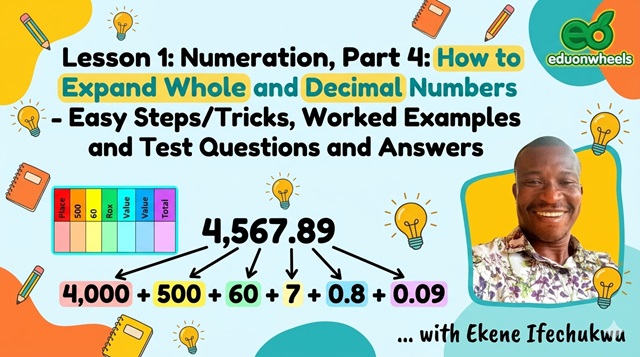
@eduonwheels Numeration: How to Compare Decimal Numbers - Steps And Tricks Lesson 1: Numeration 3. Comparing Numbers 3.1 How to Compare Decimal Numbers Steps and Tricks How to Compare Decimal Numbers | Simple Steps & Tricks | Eduonwheels Close-up of handwritten math steps showing the comparison of whole and decimal parts. Don't let the dot confuse you! 🛑✨ Compare decimals like a pro with these easy steps. Whole numbers first, then the tenths, hundredths, and beyond! 🧠📉 These math skills are essential for passing professional entrance exams or aptitude tests. Quick Quiz: Which is bigger—$0.7$ or $0.09$? Drop your answer below! 👇 Reference: 1. Kastberg, S., & Morton, C. (2014). Mathematical content knowledge for teaching elementary mathematics: A focus on decimals. The Mathematics Enthusiast, 11(2), 311–332. https://doi.org/10.54870/1551-3440.1305 2. Van de Walle, J. A., Karp, K. S., & Bay-Williams, J. M. (2018). Elementary and middle school mathematics: Teaching developmentally (10th ed.). Pearson. 3. Khan Academy. (n.d.). Comparing decimals: Place value. Retrieved April 16, 2026, from https://www.khanacademy.org 4. Eduonwheels. (2026). Lesson 1: Numeration - 3.2. How to compare decimal numbers: Steps and tricks [https://www.youtube.com/shorts/o2xVxoF7ujA?feature=share]. Eduonwheels Global Learning Series. MathTok, StudyHacks, LearnOnInstagram, Eduonwheels, DecimalTips, SchoolVibes, BritishRPEnglish, EnglishMediumMath, StandardEnglish, CommonCoreMath, keystage234, NumberSense, Numeration, PlaceValueComparison, WorkedExamples, MathsLeads, STEMCoordinators, CCSSMath, NBTA, ElementaryMath, MathHelp, Eduonwheels. GradeMath, ComparingNumbers, STEMEducation, MathHacks, MathTricks, TrikMatematika, Belajar, ProblemSolvingSteps, CriticalThinking, DecisionMaking, QuantitativeLiteracy, EdTech, InternationalStandards, InternationalSchools, CivilService ExamReviewer, UPCATMath, MathShortcuts, BritishCurriculum, IGCSEPrep, MathinEnglish, MathematicalLiteracy, AnalyticalMath, MatemáticaBásica, GlobalCurriculum, NCERT, CBSE, KS2Maths, PrimaryMaths, OntarioTeachers, MathSyllabus, NCERTMaths, KS2Maths, CAPSMaths, OntarioMath, WAECPrep, JAMBMathematics.
♬ original sound - eduonwheels - eduonwheels







0 Comments