No Results Found
The page you requested could not be found. Try refining your search, or use the navigation above to locate the post.


The page you requested could not be found. Try refining your search, or use the navigation above to locate the post.

Are you a JAMB UTME candidate in Nigeria struggling to master the Use of English section? You’re not alone! The English Language paper is a compulsory requirement for all candidates, making it a critical factor for securing university admission across Nigeria. To help you achieve a high JAMB score and ensure your exam success, Eduonwheels offers the best of JAMB exam success guide: our FREE 2019 JAMB UTME English Language Past Questions and Answers.
Stop wasting time searching for unreliable materials. Our comprehensive resource provides authentic 2019 JAMB past questions with detailed, easy-to-understand answers and explanations. Practicing with actual questions from the 2019 UTME is the most effective way to understand the exam’s format, identify your weak areas, and build the confidence you need to ace the test. Whether you’re in Lagos, Abuja, Port Harcourt, or anywhere else in Nigeria, access your free study guide today and take the definitive step towards securing your admission!
You can watch this video on JAMB CBT English 2019 Past Questions 1 – 24 for detailed explanations and solutions to the 2019 JAMB CBT Use of English Language Past Questions.

Unlock your success in the 2019 JAMB Use of English exam with free past questions and answers from Eduonwheels. Join thousands of Nigerian students boosting their scores! Images: 1
Question Key: Numbered 1 – 100
Read each passage carefully and answer the questions that follow.
PASSAGE I
The young are not listening to their elders, and perhaps they never have. But now it happens that, with many of them, the reason may be medical. The young aren’t listening because they can’t hear. Just as nagging parents have long suspected, otologists (hearing specialists) now report that youngsters are going deaf as a result of blasting their eardrums with electronically amplified rock ‘n’ roll.
The hearing specialist used to worry about loud noise as a cause of deafness only in industrial and military situations. They knew that eight hours of daily exposure, year in and year out, to the din of the proverbial boiler factory, would eventually result in permanent hearing loss. Riveters were particularly susceptible. Then they learned that the same thing happened to aviators. After the advent of jets, the hazard applied to ground crews at airports and flight-deck personnel aboard aircraft carriers – hence the introduction of insulated, noise-absorbing plastic earmuffs.
In discotheques and rock ‘n’ roll joints, the trouble is not so much in the instruments themselves, or the close quarters. The blame goes to the electronic amplifiers. An old-fashioned military band, playing a march in Ramat Park, generated as much sound. But the sound was not amplified and was dissipated in the open air. A trombonist sitting in front of a tuba player might be a bit deaf for an hour or so after a concert; then his hearing returned to normal. What did the damage was multiple microphones and speakers, and the installation of internal microphones in such instruments as guitars and bouzoukis.
Questions: 1 – 5:
1. The young are not listening to their elders because
A. they never have
B. their parents nag constantly
C. they are permanently deaf
D. they appear to be going deaf.
2. ‘Just as nagging parents have long suspected’ implies that the parents suspected that
A. their children did not listen to them
B. children could not hear properly after listening to amplified music
C. otologists were always right
D. children were disobedient because they did not listen to their parents
3. What is the result of being subjected to the din of the proverbial boiler factory for a prolonged length of time?
A. A loss of hearing which will never improve
B. total deafness eight hours a day
C. Temporary deafness
D. hearing loss which can be corrected by medical treatment
4. ‘The same thing happened to aviators’. This excerpt, according to the passage means
A. the riveters were particularly susceptible
B. industrial and military deafness
C. that continued loud noise resulted in deafness
D. that working in a boiler factory affected one’s hearing
5. What is the difference between an old-fashioned military band on the one hand and discotheques and rock ‘n’ roll joints on the other?
A. One is old-fashioned while the other is modern
B. One produces sounds for marching, the other for disco
C. One has drums, the other has guitars
D. One produces amplified sounds, the other does not
PASSAGE II
The preparation which a study of the humanities can provide stems from three observations about education in our world of accelerating social and technological change. First, with the rate of change, we cannot hope to train our students for specific technologies. That kind of vocational education is obsolescent. By the time the specific training will have been completed, the world will have moved on. If our education consists of narrow training, we will not be prepared to change.
Second, and paradoxically, what our students desire from their education is preparation for specific careers – business, engineering, medicine, computer programming and the like, but we will not be able to train them for a life-long career. Their confronting the depressed job market gives our students a certain anxiety, but the solution they seek in vocational training is not sufficient.
Third, we sense in our students a narrowing materialism, with the good life defined in terms of material comforts. Education then means learning to do a job which will make money. I see in this definition a limiting sense of what education is. The study of the humanities responds to these three related problems. In our changing, yet narrowing world, the teaching of the humanities finds one powerful justification – it teaches students how to think.
Questions: 6 – 10:
6. ‘Our world of accelerating social and technological change’ means that
A. our world is moving too fast socially and technologically
B. our world is going through more rapid social and technological change.
C. the social and technological change is more exhilarating than before.
D. the social and technological change is accelerating our world
7. What is the major weakness of training students for specific technologies?
A. it trains students for only one type of career
B. It helps students to acquire money later when they are employed
C. It makes them anxious for a job in the market
D. It cannot help students to cope with the rapid changes in the world.
8. ‘We sense in our students a narrowing materialism’ means that our students’ concept of education is one that
A. prepares them for money, joy and meaning
B. makes them ready to confront the depressed job market
C. only prepares them to acquire material comforts.
D. trains them for a life-long career.
9. According to the writer, a study of the humanities
A. is accepted by present day students as essential
B. prepares students for specific careers
C. provides a missing link in the technological education of our students
D. is the best solution to the problem of unemployment
10. What type of education does the writer advocate for our students?
A. Vocational as well as technological education
B. Business, engineering, medicine and computer programming
C. Technological education plus the humanities
D. Technological education only.
PASSAGE III
Though assumption is the lowest level of knowledge, it is still a form of knowledge, and knowledge is key. Assumptions are the foundation upon which interpretations and conclusions are built. Everything in life operates under certain assumptions.
We make management decisions based on the assumptions we hold about how management ought to function and how people ought to be governed. For some of us, we consciously imbibe assumptions and principles about life and consciously decide based on them; for others, it is unconsciously but potent all the same. Our assumptions will either drown us or help us soar through life.
We have always seen life as an immense mansion with many rooms. Some rooms lead to wealth, some to the opposite. Fortunately, we decide where we end up; and life, thus far, has proved that not every one of us decided well. We all behave differently where we have different levels of understanding, and behave the same way where our understanding is the same. We all eat because we all understand the consequences of not eating. We all wear clothes because each of us comprehends lunacy. The list goes on and on.
It is inevitable that some of us will make choices that get and keep us on the lower rung of the ladder by reason of exposure, training or some other variables. Life is about role playing. We choose our roles wisely or foolishly, consciously or unconsciously. Some of us get wiser to new levels of self-awareness enough to redefine our roles, others make no effort to build further capacity and therefore remain where they are.
It is based on these realities that we draw the conclusion that not everyone will be wealthy in life. We lead, inspire and motivate people to strive and succeed. It is also important that we paint the full and true picture of life so that we can discourage vain pursuits. Balance must be enthroned as a critical component of truth, and people know, for instance, that ‘the top’ is not a place that all must ascend.
Our greatest consolation lies in our deep conviction that true prosperity is in fulfilment through hard work rather than in intangible acquisitions. There are set roles that some of us have been wired up to play in life but which we are not content enough to play because society esteems such roles to be inferior. Take the almost sacred office of a teacher for instance, there are people who have the natural gifts and inclinations to be school teachers. But the teaching profession, as it is, does not appear to be lucrative. So we have people who would have been more fulfilled and effective working as school teachers serving in banks.
Questions: 11 – 15:
11. According to the writer, people lead and motivate others because they want to
A. project individual contribution
B. encourage selfless service
C. make the world a home
D. prevent empty search.
12. According to the passage, balance must be enthroned because it is
A. a critical interdependent functional
B. an amazing help for consciences
C. a critical part of fidelity
D. a serious way of ensuring success.
13. The word (inclinations), as used in the passage, means
A. creeds
B. tendencies
C. inhibitions
D. power
14. Which of the following statements is true according to the passage?
A. Greatness in life emerges when square pegs are put in round holes.
B. People do certain things in life because they know the repercussion.
C. People agree on all issues and behave the same way for the same reason.
D. Understanding life at different levels gives no accounts of visible acquisition.
15. From the passage, it can be inferred that
A. people insincerely discuss facts that govern their behaviour.
B. all managerial decisions are based on assumptions.
C. people make conscious efforts to acquire hidden knowledge.
D. all things in life exist on some beliefs
PASSAGE IV
Believe it or not, change is to human existence what the blood is to the human body. We live in an era of amazing 16. (A. well-defined B. fast-paced C. favourable D. social) change spawned by advancing technology and industrialisation. However, man’s 17. (A. knowledge of B. attitude to C. commitment to D. opinion of) promoting and defending change in a deliberate effort to establish 18. (A. customs B. companies C. trade-zones D. variations) that stimulates advancement for man’s concern is proving unfavourable to the climate with threatening 19. (A. repercussions B. clouds C. pressure D. implication)
Human-induced climate change has awakened widespread concern across the globe. As a matter of fact, climate change is now 20. (A. an acceptable B. a foremost C. the only D. the last) global issue. It is a major test of Africa’s 21. (A. popularity B. energy C. ingenuity D. incapability) The fourth Assessment Report (AR4) of the Intergovernmental Panel on Climate Change projects disturbances in human 22. (A. geography B. societies C. systems D. life) and ecosystems. The IPCC reports that the world has warmed by an average of 0.76°C since pre-industrial times. The rising global 23. (A. command B. demand C. warming D. supply) for energy and the adverse changes in the climate put the earth and its inhabitants in a catch-22 situation.
Again, if the effects of climate change on each continent were commensurate with the level of greenhouse 24. (A. structure B. paints C. emulsion D. emissions) it spews out, perhaps Africa would have been spared and would probably be just an amused spectator. But as it is, this is not the case. Here again, we see well meaning global citizens appealing for the rest of the world to take responsibility for the problems of Africa, a strategy that cannot, thus far, be termed 25. (A. notable B. liable C. credible D. flexible)
26. Hardworking students must not have a finger in every pie at school.
A. Hardworking students must have a role to play in most activities in the school.
B. Only hardworking students must participate in all activities in the school.
C. Hardworking students do not participate in all activities in the school.
D. Hardworking students must allow others to participate in school activities.
27. The vice chancellor is riding the crest of the last quarter of his administration.
A. The vice chancellor enjoys the acknowledgement of the success of his administration.
B. The vice chancellor does not enjoy the people’s criticism of his administration.
C. The vice chancellor hopes to overcome soon the poor comments on his administration.
D. The vice chancellor does not talk of his success in office.
28. She was absolved by the court from the charge.
A. She was convicted for the charge
B. She was blamed and charged to court
C. Her case was resolved by the court.
D. She was declared free from the charge.
29. The landlord is fond of throwing his weight about.
A. The landlord likes healthy exercise
B. The landlord is overweight
C. The landlord gives orders to people
D. The landlord is respected by the tenants
30. The company ought to have issued warrants for one billion shares.
A. The company has issued one billion shares.
B. The management expected the company to issue more than one billion shares.
C. Members of the company bought less than one billion shares.
D. The company did not issue one billion shares.
31. He needed not to have played in the position of quarterback in volleyball.
A. He participated in the game in his unusual position.
B. Nobody expected him to have participated in the game.
C. He wanted to play in a position other than the one he was offered.
D. Someone did not want him to play in the position that he played.
32. I wouldn’t have responded to his rude talk, if I were you.
A. The advice was taken by the respondent, so he did not respond to the talk.
B. The adviser put himself in the respondent’s position, so he did not respond to the talk.
C. The respondent replied to the speaker’s talk, although he ought not to have done so.
D. What was advisable was that the respondent gave back to the speaker
33. He could not speak out because he had clay feet.
A. His feet were muddy
B. He was weak and cowardly
C. He was clumsy and lazy
D. He was shy and timid
34. The player wasted a golden opportunity during the penalty shoot-out.
A. The player first hit the bar
B. The player did not score the shot
C. The player scored the shot that made them win the gold cup
D. Instead of a silver cup, they received the golden one
35. As far as Abu is concerned, Mero should be given fifty naira.
A. All Abu is saying is that Mero probably deserves more than fifty naira and not less
B. All Abu is concerned with is that Mero should be given nothing more than fifty naira
C. In Abu’s estimation, Mero merits not more than fifty naira.
D. In Abu’s opinion, Mero deserves fifty naira or probably more
In each of questions 36 to 50, choose the option opposite in meaning to the word or phrase in (italics)
36. As (an idiot), the boy is weak in class
A. a deviant
B. a dunce
C. an expert
D. a genius
37. We were (shocked) by the news that he had lost the money
A. astonished
B. disconcerted
C. unconcerned
D. surprised
38. The principal was advised to be (flexible) on critical issues
A. livid
B. cautious
C. evasive
D. rigid
39. Bola always looks (sober)
A. excited
B. serious
C. worried
D. hapless
40. Dupe was promoted for her (efficiency)
A. ability
B. incompetence
C. inconsistency
D. rudeness
41. The management wants to consider her (reticent) behaviour in due course A. disapproving
B. disciplinarian
C. contemplative
D. loquacious
42. Election processes often become (volatile)
A. calm
B. strange
C. sudden
D. latent
43. Oche entered the principal’s office in a rather (abrasive) manner
A. gentle
B. rude
C. lackadaisical
D. indifferent
44. Otokpa is a member of the (ad hoc) committee on stock acquisition
A. improvised
B. formal
C. temporary
D. fact finding
45. His gift to the poor was always (infinitesimal)
A. large
B. small
C. supportive
D. shameful
46. The economist concluded that several factors have been (adduced) to explain the fall in the birth rate.
A. affirmed
B. diffused
C. mentioned
D. refuted
47. The presidential system is an (antidote) to some political ailments.
A. an answer
B. a reply
C. an inquiry
D. an obstacle
48. Ola thought that her father was very (callous)
A. parlous
B. compassionate
C. wicked
D. cheerful
49. He was very much respected, though he had no (temporal) power.
A. spiritual
B. mundane
C. permanent
D. ephemeral
50. The way the workshop was organised was rather (hit-and-miss).
A. systematic
B. hasty
C. slow
D. funny
In each of questions 51 to 65, choose the option nearest in meaning to the word or phrase in (italics).
51. Some men will continue to cause offences until they are given (a taste of their own medicine).
A. punished
B. revenged on
C. recompensed for
D. cured
52. Okibe was rusticated for his (derogatory) remark about the principal
A. complimentary
B. unsavoury
C. unwarranted
D. lacklustre
53. Justice is difficult to enforce because people are unwilling to accept any loss of (sovereignty).
A. autonomy
B. position
C. leadership
D. kingdom
54. There are still (virtuous) women in our society today.
A. clever
B. upright
C. devilish
D. intelligent
55. The type of response is (typical) of a lazy teacher
A. symptomatic
B. characteristic
C. universal
D. incontestable
56. Akin is an (inveterate) gambler.
A. a selfish and self-centred
B. an extremely unlucky but popular
C. an incurable but fearful
D. a long time and incorrigible
57. He was too (petrified) to give the closing remarks at the conference.
A. frightened
B. delighted
C. agitated
D. happy
58. During a particular time of the day, the road (shimmers) in the heat.
A. darkens
B. lightens
C. shines
D. beams
59. Every human being is (vulnerable) to communicable diseases.
A. liable
B. lifted
C. immured
D. closed
60. Mariam looks rather (furtive) to Shehu.
A. intoxicated
B. unfriendly
C. sad
D. sly
61. The student’s union leader delivered his speech (extempore).
A. out-of-hand
B. off the cuff
C. accurately
D. courageously
62. His story gave us an (inkling) of what he passed through during the strike
A. a possible idea
B. a taste
C. a summary
D. the right view
63. These policies have been (espoused) by the ruling party
A. condemned
B. rejected
C. supported
D. outlined
64. We must not (foreclose) reconciliation as the purpose of his trip
A. exclude
B. consider
C. underestimate
D. forgo
65. Her findings (exploded) widely held beliefs about learning
A. challenged
B. debunked
C. projected
D. confirmed
For questions 66 – 85, choose the option that best completes the gap(s).
66. …, you should put in some effort.
A. However tired you are
B. However tired are you
C. However you are tired
D. However are you tired
67. Bola works in…..
A. with a meagre school resources
B. a school with meagre resources
C. school with a meagre resources
D. a resource school meagre with
68. There are…… I need to buy
A. lot of thing that
B. lots of things that
C. lot of things that
D. lots of thing that
69. It is generally…..that we should eat less fat and more vegetables
A. agreeing
B. to agreed
C. to agree
D. agreed
70. Laraba couldn’t do it as expected……?
A. wasn’t she
B. could she
C. didn’t she
D. was she
71. A…..seminar was organised by the society
A. two-day
B. two-days
C. two day
D. two days
72. Ado struck Isa with…..blow across his shoulder.
A. mightily
B. a mighty
C. mightiest
D. the mightier
73. Tunde and Kola were not supposed to attend the party…..?
A. were they
B. wasn’t they
C. weren’t they
D. isn’t they
74. The two friends agreed….each other on the issue
A. with
B. to
C. by
D. on
75. Abiola is……..
A. uses to wake up early
B. used to waking up early
C. use to wake up early
D. using to wake up early
76. ….you do, slow down and take your time
A. Whatever
B. However
C. Wherever
D. Whenever
77. The allegation was a further source…. embarrassment
A. with
B. of
C. in
D. for
78. The man … he… complete the house
A. said/couldn’t
B. say/can’t
C. said/can’t
D. saying/couldn’t
79. The new manager has … to his staff
A. a disposition pleasant friendly
B. a pleasant friendly disposition
C. a disposition friendly pleasant
D. a friendly disposition pleasant
80. My sister plays tennis with …
A. he’s
B. his
C. he
D. him
81. “We detest these …” declared the woman
A. types of programme
B. type of programmes
C. types of programmes
D. type of programme
82. Lima doesn’t like working in the dark. …?
A. has she
B. does she
C. will she
D. did she
83. Oboro will always … his friends
A. stand up for
B. stand down for
C. stand across for
D. stand beside for
84. She arrived … air for the occasion
A. for
B. in
C. with
D. by
85. Audu overbalanced and … the water
A. fell into
B. fell from
C. fell for
D. fell at
For these questions, choose the option that has the same vowel sound as the one represented by the letter(s) in (brackets).
86. B(o)re
A. call
B. curt
C. slot
D. hum
87. H(ea)d
A. said
B. heard
C. herd
D. shirt
For these questions, choose the option that rhymes with the given word.
88. Suite
A. tree
B. breath
C. bleat
D. sweet
89. Cart
A. lash
B. cat
C. part
D. pack
90. Sight
A. skate
B. short
C. cite
D. plait
For the following questions 91 to 92, choose the option that has the same consonant sound as the one represented by the letter(s) in (brackets).
91. (cl)ash
A. sharp
B. cheap
C. leisure
D. school
92. vi(c)e
A. cat
B. dress
C. show
D. chalk
For questions 93 to 94, choose the most appropriate stress pattern from the options. The stressed syllables are written in capital letters.
93. departmental
A. DEpartmental
B. dePARTmental
C. departMENtal
D. departmenTAL
94. Judiciary
A. judiCIAry
B. judiciaRY
C. JUdiciary
D. juDIciary
For the following questions 95 to 100, the word in capital letters has the emphatic stress. Choose the option to which the given sentence relates.
95. Aderonke STATED she had a right to her privacy
A. Did Omowunmi state she had a right to her privacy?
B. Did Aderonke lament she had a right to her privacy?
C. Did Aderonke state she had a right to her openness?
D. Did Aderonke state she had a right to his privacy?
96. My boss has an amiable DISPOSITION
A. Does your boss have an amiable disposition?
B. Does my boss have an unfriendly disposition?
C. Does my colleague have an amiable disposition?
D. Does my boss have an amiable complexion?
97. Adamu is leaving a CAR behind.
A. Is Adamu driving the car in front?
B. Who is leaving a car behind?
C. Where is Adamu leaving a car?
D. What is Adamu leaving behind?
98. Lambusa TOOK OFF the wig.
A. What did Lambusa do?
B. Did Lambusa take off a wig?
C. Did Lambusa take off the ring?
D. Who took off the wig?
99. The bed is IN the room
A. Was the bed in the room?
B. What is in the room?
C. Where is the bed?
D. Is the bed in the parlour?
100. My mother bought a BICYCLE yesterday
A. Whose mother bought a bicycle yesterday?
B. Did my mother steal a bicycle yesterday?
C. When did my mother buy a bicycle?
D. What did my mother buy yesterday?
Ready to ace the Use of English paper? Download your free JAMB UTME English Language Past Questions and Answers for 2019 and boost your exam preparation today! Images: 2
You will find in our other Use of English Past Questions and Answers:
JAMB UTME English Language (Use of English) Past Questions and Answers: Repeated Questions 2001 – 2025
JAMB UTME English Language (Use of English) Past Questions and Answers: Topics, including New Topics
JAMB UTME English Language (Use of English) Past Questions and Answers PDF 2001 – 2025
JAMB UTME English Language (Use of English) Past Questions and Answers: Likely Questions 2026 – 2030
Preparatory Tests on JAMB UTME English Language (Use of English) Past Questions and Answers: MCQ
Answers: Numbered 1 – 100

Get your JAMB UTME English Language (Use of English) Past Questions and Answers Free 2019! Join thousands of students using Eduonwheels to master Comprehension, Lexis & Structure, Antonyms & Synonyms, and Phonetics for exam success.Images: 3
Answer Explanations: Numbered 1 – 100
1. D – The passage states that youngsters are “going deaf” due to amplified rock music, which means they appear to be losing their hearing progressively.
2. B – The parents suspected that exposure to loud amplified music was affecting their children’s hearing, which otologists later confirmed.
3. A – The passage explicitly states that prolonged exposure to loud noise “would eventually result in permanent hearing loss” – meaning it will never improve.
4. C – The phrase refers to aviators experiencing the same permanent hearing loss from prolonged exposure to loud noise that riveters experienced.
5. D – The key difference is that discotheques use electronic amplifiers whilst old-fashioned military bands did not amplify their sound.
6. B – “Accelerating” means increasing in speed, so the world is going through more rapid social and technological change.
7. D – The passage states that specific technological training becomes obsolete because “by the time the specific training will have been completed, the world will have moved on.”
8. C – The passage explains that narrowing materialism means students view education only as preparation to make money for material comforts.
9. C – The writer argues that humanities provides what technological education lacks – it teaches students how to think, thus filling a gap.
10. C – The writer advocates for combining technological education with humanities training to prepare students for a changing world.
11. D – The passage states leaders motivate people whilst also painting “the full and true picture of life so that we can discourage vain pursuits” – preventing empty searches.
12. C – The passage says “Balance must be enthroned as a critical component of truth” – making it a critical part of fidelity/truthfulness.
13. B – “Inclinations” means natural tendencies or preferences towards something.
14. B – The passage states “We all eat because we all understand the consequences of not eating” – people act based on knowing repercussions.
15. D – The passage begins by stating “Everything in life operates under certain assumptions” – all things exist on some beliefs.
16. B – “Fast-paced” fits the context of rapid technological and industrial change.
17. B – “Attitude to” makes grammatical sense in describing man’s approach to promoting change.
18. D – “Variations” logically completes the idea of establishing different approaches that stimulate advancement.
19. A – “Repercussions” (consequences) fits with the threatening nature of climate change.
20. B – “A foremost” (primary/leading) global issue makes the most sense contextually.
21. C – “Ingenuity” (cleverness/resourcefulness) is being tested by climate change challenges.
22. C – “Systems” works best with “human” to describe societal and organisational structures.
23. B – “Demand” for energy makes logical sense in the context.
24. D – “Emissions” is the standard term for greenhouse gases released.
25. C – “Credible” (believable/reliable) fits the context of evaluating the strategy.
26. C – “Having a finger in every pie” means being involved in everything; “must not” means they don’t participate in all activities.
27. A – “Riding the crest” means enjoying the peak/success of something.
28. D – “Absolved” means cleared or freed from blame/charges.
29. C – “Throwing one’s weight about” means acting in a domineering manner, giving orders.
30. D – “Ought to have issued” indicates they should have but didn’t issue the shares.
31. A – “Needed not to have played” suggests he did play in that unusual position despite not needing to.
32. C – The conditional “wouldn’t have” implies the respondent did respond but shouldn’t have.
33. B – “Clay feet” is an idiom meaning a hidden weakness or character flaw, indicating cowardice.
34. B – “Wasted a golden opportunity” means failed to score/take advantage of an excellent chance.
35. D – “As far as Abu is concerned” indicates Abu’s opinion that Mero deserves fifty naira or possibly more.
36. D – The opposite of “an idiot” is “a genius.”
37. C – The opposite of “shocked” (surprised negatively) is “unconcerned” (not bothered).
38. D – The opposite of “flexible” (adaptable) is “rigid” (inflexible).
39. A – The opposite of “sober” (serious/sad) is “excited” (happy/lively).
40. B – The opposite of “efficiency” (competence) is “incompetence” (inability).
41. D – The opposite of “reticent” (reserved/quiet) is “loquacious” (talkative).
42. A – The opposite of “volatile” (unstable/explosive) is “calm” (peaceful/stable).
43. A – The opposite of “abrasive” (harsh/rough) is “gentle” (soft/mild).
44. B – The opposite of “ad hoc” (temporary/improvised) is “formal” (permanent/official).
45. A – The opposite of “infinitesimal” (extremely small) is “large.”
46. D – The opposite of “adduced” (cited/brought forward as evidence) is “refuted” (disproved/rejected).
47. D – The opposite of “antidote” (cure/solution) is “obstacle” (hindrance/barrier).
48. B – The opposite of “callous” (cruel/unfeeling) is “compassionate” (sympathetic/caring).
49. C – The opposite of “temporal” (temporary/worldly) is “permanent” (lasting/enduring).
50. A – The opposite of “hit-and-miss” (random/disorganised) is “systematic” (methodical/organised).
51. A – “A taste of their own medicine” means being subjected to the same treatment one gives others – being punished.
52. B – “Derogatory” means insulting or disparaging – “unsavoury” (unpleasant/offensive) is nearest in meaning.
53. A – “Sovereignty” means supreme authority or independence – “autonomy” is nearest in meaning.
54. B – “Virtuous” means having high moral standards – “upright” (moral/honest) is nearest in meaning.
55. B – “Typical” means characteristic or representative of a type – “characteristic” is the nearest synonym.
56. D – “Inveterate” means habitual/confirmed in a practice – “long time and incorrigible” is nearest in meaning.
57. A – “Petrified” means extremely frightened – “frightened” is the direct synonym.
58. C – “Shimmers” means shines with a soft tremulous light – “shines” is nearest in meaning.
59. A – “Vulnerable” means susceptible to harm – “liable” (exposed/susceptible) is nearest in meaning.
60. D – “Furtive” means secretive or stealthy – “sly” (cunning/sneaky) is nearest in meaning.
61. B – “Extempore” means without preparation – “off the cuff” (impromptu) is nearest in meaning.
62. A – “An inkling” means a slight hint or indication – “a possible idea” is nearest in meaning.
63. C – “Espoused” means adopted or supported – “supported” is the direct synonym.
64. A – “Foreclose” means rule out or prevent – “exclude” is nearest in meaning.
65. B – “Exploded” in this context means disproved or debunked – “debunked” is nearest in meaning.
66. A – “However tired you are” is the correct word order for this concessive clause.
67. B – “A school with meagre resources” has the correct article usage and word order.
68. B – “Lots of things that” is grammatically correct (plural noun requires plural verb).
69. D – “It is generally agreed” uses the passive voice correctly with the past participle.
70. B – “Could she” is the correct question tag for the negative statement with “couldn’t.”
71. A – “A two-day seminar” uses the hyphenated compound adjective correctly.
72. B – “A mighty blow” requires the article “a” before the adjective “mighty.”
73. A – “Were they” is the correct question tag for the negative statement “were not supposed.”
74. A – “Agreed with each other” is the correct prepositional phrase.
75. B – “Used to waking up early” correctly expresses habitual action using “used to” + gerund for current habits.
76. A – “Whatever you do” is the correct structure meaning “no matter what you do.”
77. B – “Source of embarrassment” requires the preposition “of.”
78. A – “Said/couldn’t” maintains correct tense consistency in reported speech.
79. B – “A pleasant friendly disposition” follows the correct order: article + opinion adjective + descriptive adjective + noun.
80. D – “With him” requires the objective pronoun “him” as the object of the preposition.
81. C – “Types of programmes” uses the correct plural forms for both nouns.
82. B – “Does she” is the correct question tag for the negative statement with “doesn’t.”
83. A – “Stand up for” is the correct phrasal verb meaning to support or defend.
84. D – “Arrived by air” uses the correct preposition for mode of transport.
85. A – “Fell into the water” uses the correct preposition showing movement into something.
86. A – “Bore” has the /ɔː/ sound, which is the same vowel sound in “call.”
87. A – “Head” has the /e/ sound, which is the same vowel sound in “said.”
88. D – “Suite” rhymes with “sweet” (both pronounced /swiːt/).
89. C – “Cart” rhymes with “part” (both end with the /ɑːt/ sound).
90. C – “Sight” rhymes with “cite” (both pronounced /saɪt/).
91. A – “Clash” has the /ʃ/ sound at the end, which is the same consonant sound in “sharp.”
92. B – “Vice” has the /s/ sound, which is the same consonant sound in “dress.”
93. C – “Departmental” is stressed on the third syllable: depart-MEN-tal.
94. D – “Judiciary” is stressed on the third syllable: ju-DI-ciary.
95. B – The emphasis on “STATED” contrasts with “lament” – questioning whether she stated or lamented.
96. D – The emphasis on “DISPOSITION” contrasts with “complexion” – questioning whether it’s disposition or complexion.
97. D – The emphasis on “CAR” answers the question “What is Adamu leaving behind?”
98. C – The emphasis on “TOOK OFF” contrasts with other actions, and option C asks if she took off the ring instead of the wig.
99. D – The emphasis on “IN” contrasts with other locations, questioning whether the bed is in the room or in the parlour.
100. D – The emphasis on “BICYCLE” answers the question “What did my mother buy yesterday?”. The management wants to consider her (reticent) behaviour in due course**
‘JAMB UTME English Language (Use of English) Past Questions and Answers Free 2019: Conquer JAMB English! Get Your Free 2019 Past Questions and Answers Now’

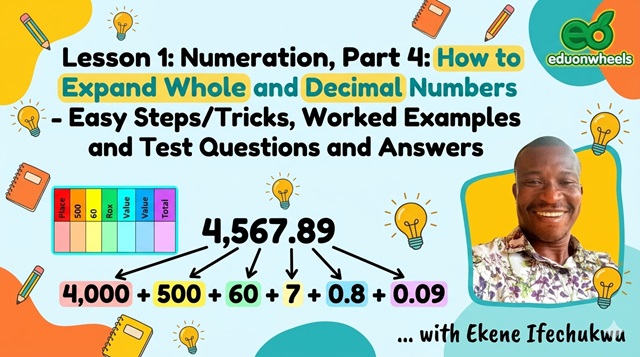
@eduonwheels Numeration: How to Compare Decimal Numbers - Steps And Tricks Lesson 1: Numeration 3. Comparing Numbers 3.1 How to Compare Decimal Numbers Steps and Tricks How to Compare Decimal Numbers | Simple Steps & Tricks | Eduonwheels Close-up of handwritten math steps showing the comparison of whole and decimal parts. Don't let the dot confuse you! 🛑✨ Compare decimals like a pro with these easy steps. Whole numbers first, then the tenths, hundredths, and beyond! 🧠📉 These math skills are essential for passing professional entrance exams or aptitude tests. Quick Quiz: Which is bigger—$0.7$ or $0.09$? Drop your answer below! 👇 Reference: 1. Kastberg, S., & Morton, C. (2014). Mathematical content knowledge for teaching elementary mathematics: A focus on decimals. The Mathematics Enthusiast, 11(2), 311–332. https://doi.org/10.54870/1551-3440.1305 2. Van de Walle, J. A., Karp, K. S., & Bay-Williams, J. M. (2018). Elementary and middle school mathematics: Teaching developmentally (10th ed.). Pearson. 3. Khan Academy. (n.d.). Comparing decimals: Place value. Retrieved April 16, 2026, from https://www.khanacademy.org 4. Eduonwheels. (2026). Lesson 1: Numeration - 3.2. How to compare decimal numbers: Steps and tricks [https://www.youtube.com/shorts/o2xVxoF7ujA?feature=share]. Eduonwheels Global Learning Series. MathTok, StudyHacks, LearnOnInstagram, Eduonwheels, DecimalTips, SchoolVibes, BritishRPEnglish, EnglishMediumMath, StandardEnglish, CommonCoreMath, keystage234, NumberSense, Numeration, PlaceValueComparison, WorkedExamples, MathsLeads, STEMCoordinators, CCSSMath, NBTA, ElementaryMath, MathHelp, Eduonwheels. GradeMath, ComparingNumbers, STEMEducation, MathHacks, MathTricks, TrikMatematika, Belajar, ProblemSolvingSteps, CriticalThinking, DecisionMaking, QuantitativeLiteracy, EdTech, InternationalStandards, InternationalSchools, CivilService ExamReviewer, UPCATMath, MathShortcuts, BritishCurriculum, IGCSEPrep, MathinEnglish, MathematicalLiteracy, AnalyticalMath, MatemáticaBásica, GlobalCurriculum, NCERT, CBSE, KS2Maths, PrimaryMaths, OntarioTeachers, MathSyllabus, NCERTMaths, KS2Maths, CAPSMaths, OntarioMath, WAECPrep, JAMBMathematics.
♬ original sound - eduonwheels - eduonwheels




0 Comments